Today's
EarthStation1.com 15% (Or More!) Off Commemorative Memorial Title:
The Celts TV Series On Celtic History & Culture DVD Download
USB Drive
Today, August 1, 2026
August 1: Lughnasadh: -- A Gaelic festival observed by the Irish, Scottish, Manx, Celtic neopagans, and Wiccans to mark the start of the harvest season. An official holiday in Ireland, it was historicall widely observed throughout Ireland, Scotland and the Isle of Man. In Modern Irish it is called Lunasa, in Scottish Gaelic: Lunastal, and in Manx: Luanistyn. Traditionally it is held on August 1, or about halfway between the summer solstice and autumn equinox. In recent centuries some of the celebrations have been shifted to the Sunday nearest this date. Lughnasadh is one of the four Gaelic seasonal festivals, along with Samhain, Imbolc and Beltane. It corresponds to other European harvest festivals such as the Welsh Gwyl Awst and the English Lammas. Lughnasadh is mentioned in some of the earliest Irish literature and has pagan origins. The festival itself is named after the god Lugh. It inspired great gatherings that included religious ceremonies, ritual athletic contests (most notably the Tailteann Games), feasting, matchmaking, and trading. Lughnasadh occurred during a very poor time of the year for the farming community when the old crops were done and the new ones not yet ready for harvest. Traditionally there were also visits to holy wells. According to folklorist Maire MacNeill, evidence shows that the religious rites included an offering of the First Fruits, a feast of the new food and of bilberries, the sacrifice of a bull, and a ritual dance-play in which Lugh seizes the harvest for mankind and defeats the powers of blight. Many of the activities would have taken place on top of hills and mountains. Lughnasadh customs persisted widely until the 20th century, with the event being variously named 'Garland Sunday', 'Bilberry Sunday', 'Mountain Sunday' and 'Crom Dubh Sunday'. The custom of climbing hills and mountains at Lughnasadh has survived in some areas, although it has been re-cast as a Christian pilgrimage. The best known is the 'Reek Sunday' pilgrimage to the top of Croagh Patrick on the last Sunday in July. A number of fairs are also believed to be survivals of Lughnasadh, for example, the Puck Fair. Since the late 20th century, Celtic neopagans have observed Lughnasadh, or something based on it, as a religious holiday. In some places, elements of the festival have been revived as a cultural event. On Sale Until Midnight Tonight PT! https://store.earthstation1.com/the-celts-dvd-set-tv-series-all-6-shows-celtic-history-3-dis63.html
Today's
EarthStation1.com 15% (Or More!) Off Commemorative Memorial Title:
WWI: A History In Pictures World War I JPG Photos CD, Download,
USB
Today, August 1, 2026
August 1: Lammas Day: -- A wheat harvest festival that is also known as Loaf Mass Day. The holiday encourages celebrations and mass gatherings where individuals thank God for the first harvest of the season. According to tradition, a loaf of bread has to be taken to mass on Lammas Day, hence, it is not a surprise that it is famously recognized as 'Loaf Mass Day.' Though Lammas Day originated as a Christian holiday, it is also celebrated by others who want to offer thanks to spiritual entities for blessing the world with a fruitful wheat harvest for a particular year. Due to superstitions and religious beliefs of people, harvest festivals such as Lammas Day have been a part of ancient history. In the early times, sacrifices were often made to the gods to yield a fruitful harvest. In fact, according to Greek mythology, Adonis was the god of grain and rebirth. Although the religious aspect may be less apparent today, the spirit of gratitude and sharing the harvest with the whole community exists even today. One of the harvesting festivals that are celebrated across the world is Lammas Day - an occasion that marks the day of the first harvest. It also serves as a warning of the arrival of the fall season and is considered a time when communities start gathering food for the winter. As mentioned in a book published in 1838 by William Hone, the celebrations on this day included the building of towers and the competition of breaking down the towers of others. According to historical records, some of these competitions proved to be dangerous and often lead to serious injuries and even cases of death. Another ancient Lammas tradition in Scotland included a Burryman marching around town with a crown of roses and a staff. This was known as the Burryman ritual. By the 20th century, the celebrations evolved into Lammas fairs that included market stalls, food, and drinks. One of the largest and most remembered Lammas fairs was held at Kirkwall in Orkney. According to the rules of the festival, couples could enter into a year-long temporary union and then later decide if they want to delve further into the commitment. On Sale Until Midnight Tonight PT! https://store.earthstation1.com/wwi-a-history-in-pictures-world-war-i-photo-cd.html
Today's
EarthStation1.com 15% (Or More!) Off Commemorative Memorial Title:
TV Commercials: The Classics Vol. 9 DVD, MP4 Download, USB Flash
Drive
Today, August 1, 2026
August 1: National Spritz Day: -- Situated at the end of summer, National Spritz Day offers an ideal opportunity to enjoy some delightful and refreshing spritz beverages. The combination of warm weather and refreshing bubbles combine together to make a festive experience whether with an Aperol spritz, a champagne cocktail, a French 75 cocktail or some other delicious spritz drink! The history of National Spritz Day can be followed all the way back to the 1800s when wine drinks were combined with sparkling soda water to create a new kind of cocktail. The story goes that this was created in Italy during the time of the Austro-Hungarian Empire, when Austrian soldiers traveled to Italy and changed the way they drank wine. The name likely came from the fact that spritz means "splash" in German, referring to the splash of soda water that was placed in the wine. Since that time the spritz drink has evolved to become a combination of certain liqueurs, particularly bitters, with prosecco or champagne or club soda, often with a garnish or a citrus twist. While the Aperol Spritz has become one of the more popular of the drinks in this family, there are a number of other delicious spritz drinks that can be enjoyed hailing not only from Italy, but all over the world. The Aperol company started making their orange bitter liqueur in the early 1900s but the recipe for the Aperol Spritz didn't evolve until the 1950s. But it wasn't until several decades later, in the 2000s, that the Aperol company made a marketing push and the cocktail really began to become popular across the ocean in the United States. While Aperol has a flavor that is a lot like Campari, this one has a much lower alcohol content, making the Aperol Spritz a refreshing drink that has a low alcohol content. Other popular versions of spritz drinks can include almost any type of bitter combined with sparkling wine and club soda. This might include kiwi, mimosa, honey-lemon, Pimm's spritz and so many others. National Spritz Day was established with the desire to promote these delicious cocktails and have some fun with them. National Spritz Day offers a delightful opportunity to celebrate and enjoy this refreshing beverage! On Sale Until Midnight Tonight PT! https://store.earthstation1.com/tv-commercials-the-classics-vol-9-dv9.html
Today's
EarthStation1.com 15% (Or More!) Off Commemorative Memorial Title:
Classic Old Time Radio Commercials MP3 Set CD, Download, USB Drive
Today, August 1, 2026
August 1: International Can-It-Forward Day: -- This fun holiday celebrates canning as a method for preserving local produce and making it more accessible to people. So, whether you've got a bushel of turnips or a mountain of mushrooms, International Can-It-Forward Day is when you want to start your canning journey! Canning was developed as part of a concerted effort made by the French government, which offered a significant cash award to anyone who could invent a way to preserve food in large amounts. The discovery that food cooked inside a jar wouldn't spoil was the beginning of canning, and food began to be preserved in glass jars. Over time, the glass jars evolved into tin cans. Initially, the process was laborious and time-consuming, making canning quite expensive. Only people who could afford to spend money on expensive glass jars and metal tins would be able to can their produce. Still, the preservation method was valuable, especially for the armed forces who needed supplies that would last for long periods. Middle-class households in Europe took to canning as a novelty, but it wasn't until the mechanization of the canning process that the method became a popular way of preserving food. Soon canned food spread out of Europe into America, and while it was popular during wars, it was also an easy and cheap way to keep a variety of food conveniently accessible. Today, canning has spread beyond the industrial process and become accessible to the average home gardener and food enthusiast, with several home canning tools and products becoming readily available. With the growing interest in home canning, companies producing canning tools began to actively celebrate fresh canning and started the International Can-It-Forward Day. On Sale Until Midnight Tonight PT! https://store.earthstation1.com/classic-radio-commercials-old-time-radio-mp3-c3.html
Today's
EarthStation1.com 15% (Or More!) Off Commemorative Memorial Title:
WWII: US Pop Vs Third Reich Marching Songs MP3 Set DVD, Download,
USB
Today, August 1, 2026
August 1: Homemade Pie Day: -- Today's a day to celebrate pie, a dish that has existed since the era of the ancient Egyptians. Pies have featured in one form or another in several cultures around the world, from the ancient Greeks to the Romans to the British and eventually, the Americans. Today, pie has become a symbol of American life. It can be eaten as a meal, as a dessert, or as a snack. The ancient Egyptians are the earliest-known civilization to have had a pie dish. It typically consisted of a crust made from wheat, oats, rye, or barley and filled with honey. The ancient Greeks and Romans also had pastries similar to the modern-day pie. For instance, the Romans often coated meat with a pastry made out of flour, oil, and water. However, this dough was only intended to preserve the meat and not eaten as a meal. A Roman cookbook entitled "Apicius," dating back to the first century was discovered to contain recipes similar to pie cases. In Great Britain, pies were often referred to as 'coffyns.' They were mainly used as a covering to preserve meat, especially on long sea voyages as fresh meat could not be obtained. During medieval times, these pies became more elaborate as cooks tried to outdo each other in presentation. At grand banquets, pies were often the centerpiece of the food table as the pie cases were removed to reveal the delicious fillings underneath. Sometimes, live actors or musicians were hidden inside pies to burst out as a surprise. Until the 15th century, pies usually only contained meat or fish, but they soon included fruits and custard. It is reported that the very first cherry pie was baked for Queen Elizabeth I during the 16th century. As English settlers arrived in America, pies came along with them. Early versions often had thick, heavy crusts of rough flour and suet. Pies soon became a trademark American dish and today are heavily associated with traditional American life. When soldiers were asked why they were going off to war during World War II, they replied, "For mom and apple pie." On Sale Until Midnight Tonight PT! https://store.earthstation1.com/wwii-us-pop-and-third-reich-marching-songs-mp3-dv3.html
Today's
EarthStation1.com 15% (Or More!) Off Commemorative Memorial Title:
Classic Family Values Films 1934-1957 DVD, Video Download, USB
Drive
Today, August 1, 2026
August 1: Respect For Parents Day: -- This day is treated as the perfect starting point to teach young children about respecting their parents and other parental figures in their lives. It is also a great day to express your gratitude and love for your parents by celebrating the day with them. Respect For Parents Day was started as a way to appreciate all parents who have selflessly dedicated their lives to their children and have worked tirelessly to give them a happy and safe childhood. The day celebrates the eternal love between children and their parents. Respect For Parents Day recognizes not only the leadership roles that parents play in a child's life but also in our communities. Parents are entrusted with the first expression of love and sense of security that a child experiences. Parents are our first protectors and nurturers, and they set a foundation for leading and teaching us to grow up to be good human beings. Parents also influence our communication, decision-making skills, and how we correct our mistakes. A parent's role in the community is indispensable, too. Marilyn Dalrymple of Lancaster, CA started Respect For Parents Day in an effort to "make our families become united and strong by recognizing the leadership roles parents have, and to reinstate the respect for parents that was evident in the past." This day reminds us that parents deserve respect, and to consider the value that parents have in society. This isn't limited to just our birth parents, but anyone who plays the role of a parent figure in our lives -- including grandparents, uncles and aunts, and godparents. Many believe that the holiday might have originated from the simple human desire to honor and appreciate the love and care of parents. So much so that the Respect For Parents Day celebration officially started in the U.S. in the year 1994 with the sincere efforts of President Bill Clinton. Many organizations, local governments, and other communities celebrate the day by organizing various activities and games. You will also find proclamations and rallies organized by the United Civil Rights Councils of America in honor of the day. On Sale Until Midnight Tonight PT! https://store.earthstation1.com/classic-family-values-films-193419341957.html
Today's
EarthStation1.com 15% (Or More!) Off Commemorative Memorial Title:
TV Commercials: The Mego Toy Classics DVD, MP4 Download, USB Drive
Today, August 1, 2026
August 1: Spider-Man Day: -- With great power comes great responsibility. As a Spider-Man fan, have all the power in the world to celebrate one of the most iconic comic-book superheroes of all time whichever way you want to, so don't take this responsibility lightly. This is your gift! Created by Steve Dikto and Stan Lee, Spider-Man is Marvel Comics most iconic character for the past 59 years. For all true fans of the web-slinger, August 1, 2021 is the day on which you can appreciate what Spider-Man has brought to your lives. Everyone loves "Spider-Man! Spider-Man! Friendly neighborhood Spider-Man!" And how can we not? Spider-Man entered the comic-book universe in issue 15 of Marvel Comics' "Amazing Fantasy" in August 1962 and has been a major player ever since. The groundbreaking story caught the attention of readers when it featured an awkward, antisocial teenager as its superhero - a description typically associated with sidekicks. But this bold move turned out to be a boon for creator Stan Lee, who touched the hearts of a generation of kids who felt lonely, rejected, or had difficulty making friends. Spider-Man proved that anyone can be a superhero and, even after being around for about 60 years, he's still as popular as ever. Spider-Man got his own comic series, "The Amazing Spider-Man," in March 1963. The titular character rose to popularity and quickly became integral in the ever-expanding Marvel Universe, engaging with regularly featured characters like the Human Torch, the Incredible Hulk, and Daredevil. The supporting characters in the Spider-Man world were equally interactive and colorful, enthralling readers who developed soft spots for them. This includes J. Jonah Jameson, the anti-Spider-Man editor-in-chief for the "Daily Bugle" newspaper, Spider-Man's love interests Gwen Stacy and Mary Jane Watson, and costumed villains like Doctor Octopus, the Green Goblin, and Venom. Spider-Man became a fast-expanding franchise, his heroics no longer able to be contained in single monthly issues. Spidey's frequent crossover storylines with other Marvel characters led to the creation of the bimonthly series "Marvel Team-Up" in March 1972, which ran for 150 issues. Spider-Man teamed up with nearly every high-profile superhero in the Marvel Universe in this ongoing series. "Peter Parker: The Spectacular Spider-Man" was the fourth installment comic series of Spider-Man's continuing adventures. It debuted in December 1976 and ended after 263 issues. One of the most memorable events of this era was Peter's marriage to Mary Jane Watson. We all know Spider-Man is fast, but his momentum in the comic world was soon noticed by Hollywood as well. Sony Entertainment purchased the rights to Spider-Man, and brought him to the big screen in May 2002 with the movie "Spider-Man." With Tobey Maguire playing the friendly neighborhood superhero, the Spider-Man movies paved the way for the Marvel Cinematic Universe and the superhero movie genre. "Spider-Man 2" was released in 2004 and broke box-office records, followed by "Spider-Man 3" in 2007, which ended Director Sam Raimi's trilogy. The franchise was rebooted five years later, with "The Amazing Spider-Man" in 2012, starring Andrew Garfield. Next, Spider-Man made his debut in the Marvel Cinematic Universe in the third act of "Captain America: Civil War" (2016). Young actor Tom Holland breathed life into the web-slinger, who had been neglected due to the ongoing legal issues and character rights between Sony Entertainment and Marvel Studios. The latest Marvel movies featuring Spider-Man are worldwide blockbusters "Avengers: Infinity War" (2018) and "Spider-Man: Far From Home" (2019). On Sale Until Midnight Tonight PT! https://store.earthstation1.com/tv-commercials-the-mego-toy-classics-dvd.html
Today's
EarthStation1.com 15% (Or More!) Off Commemorative Memorial Title:
When Baseball Went To War: Baseball & Its Players During WWII
MP4 DVD
Today, August 1, 2026
August 1: Play Ball Day: -- Made just for the kids, this day was created by Major League Baseball (M.L.B.) and USA Baseball to encourage the participation of young children in the fields of softball and baseball. This initiative shows fun and interesting ways baseball can be played and enjoyed. By encouraging formal and casual participation, children will be able to engage in skill-developing activities that are exciting. The program also allows children to find their passions and have a foot into the possibility of a future career in sports. Baseball is an exciting sport for people of all age groups. It is, however, an even bigger thrill for young children to experience. That is why the Little League Baseball and Softball organization has millions of members worldwide. Little League Baseball and Softball is an organization that arranges youth baseball and softball leagues throughout America and the world at large. It is made up of children between the age of four to 16. Local volunteers organize leagues that are chartered through Little League International creating several divisions of little leagues that are easily accessible by the children. It was founded by Carl Stotz in 1939 in Williamsport, Pennsylvania, and the first Little League Baseball World Series was played in 1947. The little league was restricted to allow only boys to participate until the rule was revised in 1974. There are currently over 2.6 million children in Little League Baseball worldwide. In 2015, Major League Baseball (M.L.B.) partnered with USA Baseball and USA Softball to create the 'Play Ball Initiative' to encourage the participation of people of all age groups, especially the youth, in baseball and softball activities. Events such as the 'Jr. Home Run Derby' and the 'Softball Breakthrough Series' are organized across the country to get aspiring athletes involved in the sports. Play Ball Day also highlights the different exciting ways baseball and softball could be played aside from the organized leagues and tournaments. These methods include a range of methods, from a simple game of 'catch' or 'wiffle ball,' to skill competitions like 'Pitch Hit & Run.' M.L.B. and USA Baseball created Play Ball Day to be observed annually on August 1 and to encourage children to expand their sporting skills through baseball. On Sale Until Midnight Tonight PT! https://store.earthstation1.com/when-baseball-went-to-war-baseball-and-its-players-during-wwii-mp4-dvd.html
Today's
EarthStation1.com 15% (Or More!) Off Commemorative Memorial Title:
Tommy: The Who In Concert 1989 DVD, Video Download, USB Flash
Drive
Today, August 1, 2026
August 1: National Pinball Day: -- While many people might see a pinball machine and think of an antiquated game, the popularity of this unique and fascinating game is on the rise again. In fact, in 2006 there were only 50 competitions with around 500 players but by 2021 those numbers had grown to 37,000 competitions and more than 84,000 players! This ageless, timeless, genderless game that is basically void of nationality offers a myriad of opportunities for pretty much anyone of any skill level to play and enjoy pinball, whether in arcades, restaurants or bars. National Pinball Day has arrived to show some love and appreciation to this game and those who play it. When folks during the Great Depression were looking for a cheap form of entertainment, the game pinball was born. With roots that can be traced back to 18th century Europe, or perhaps even further, the concept of the game wasn't necessarily new, but the execution came about in the early 1930s. By the late 1940s, flippers were introduced and the essence of the game of pinball hasn't changed a whole lot since that time. Although the mechanics of the game are not so different, pinball's popularity has ebbed and flowed at different times. For instance, in a somewhat misguided effort to reduce crime and gambling, New York City outlawed pinball from 1947-1976. Other cities followed suit and, especially in Chicago, pinball even became associated with organized crime for a little while. Pinball gained a bit of their reputation back in 1976 when Roger Sharpe, a representative from the Amusement and Music Operators Association (AMOA), testified in court that pinball should be recognized as a game of skill and not of chance. But even with that official testimony, pinball still didn't recover quickly. Sadly, with the advent of video games in the 1980s, the game of pinball machines were set aside to make way for newfangled games like Pac-Man, Asteroids and Space Invaders. Pinball took a nosedive in popularity, with many of the major manufacturers of pinball machines getting out of the game entirely. But the story isn't over yet! Starting in the late 2010s, this game that seemed almost dead was revived once again, bringing a new amount of energy and popularity to the game. New manufacturers began popping up, pinball competitions and championships were restored, and the game of pinball made an official comeback over the next several years. 2018 brought the induction of the game of pinball into the Strong Museum's National Toy Hall of Fame in Rochester, New York. And a petition for the US Senate to recognize National Pinball Day took place the following year. Although this official recognition didn't come to fruition, the celebration is still legitimate in the eyes of pinball lovers worldwide! The inaugural celebration of National Pinball Day took place in 2019 and has been enjoyed annually ever since. The date was chosen to coincide with the birthday of Mr. Roger Sharpe and was also coordinated as the start of that year's Pinburgh, one of the largest ever pinball conventions, which includes the annual World Pinball Championships. On Sale Until Midnight Tonight PT! https://store.earthstation1.com/tommy-the-who-in-concert-live-dvd-universal-amphitheater-890824.html
Today's
EarthStation1.com 15% (Or More!) Off Commemorative Memorial Title:
Heart Of The Dragon TV Series DVD, Video Download, USB Flash Drive
Today, August 1, 2026
August 1: International Mahjong Day: -- Time to head out to your local mahjong parlor, deal a game and get the celebration started! Play your tiles well, and perhaps you'll honor the day with a win! The 19th-century strategy game became popular in the United States in the 1920s. While we play the game with tiles, it's much like rummy. The players meld beautifully designed tiles with Chinese characters and symbols to earn points. Melds include pongs, kongs, chows, and the mighty Mahjong. Because Mahjong traveled great distances, it challenges people from many different backgrounds. As a result, Mahjong also breaks down communication barriers, bringing neighborhoods and communities together. Since people of all ages play, the game also bridges the gap between generations. There are also a variety of styles of Mahjong, including American, Hong Kong, Singapore, and Japanese, just to name a few. Find the version you enjoy best to play. Learn several different ways to play and play them all. If you've never played, the season is perfect to learn. Riichi Mahjong Central founded International Mahjong Day to increase the awareness of Mahjong and how to play. Japanese style Mahjong is growing in popularity in Japan. This platform especially lends itself to a social element. As a result, professional leagues, much like those in the United States, are growing, too. On Sale Until Midnight Tonight PT! https://store.earthstation1.com/heart-of-the-dragon-dvds-post-mao-china-all-12-tv-shows-3-di123.html
Today's
EarthStation1.com 15% (Or More!) Off Commemorative Memorial Title:
Clive James' Fame In The 20th Century TV Series DVD Set MP4 USB
Drive
Today, August 1, 2026
August 1: National Mountain Climbing Day: -- Mountain climbing is a sport that offers exciting adventures, reaching amazing heights that provide incredible views - and perhaps an even more incredible sense of accomplishment! National Mountain Climbing Day is here to celebrate this remarkable sport and those who participate in it. Beginning as more of a necessity than a hobby, mountain climbing has grown and developed over the years to be an incredible sport. Sometimes called mountaineering, this type of activity has become even more accessible with modern equipment, experience, and the clubs or groups that have worked together to support each other. The celebration of National Mountain Climbing Day was established to honor the efforts of two mountain climbers: Josh Madigan and Bobby Matthews. These two dedicated climbers successfully completed climbs of all 46 peaks of New York's Adirondack Mountains. They reached their final peak, Whiteface, on August 1, 2015, and the day has been celebrated on this day annually ever since. However, the significance of the first day of August in mountain climbing history reaches back much farther. In fact, it was on August 1,1898 when the first successful climb took place on the Grand Teton in Wyoming. National Mountain Climbing Day celebrates both of these incidents, as well as all of the incredible feats of strength and stamina that have been made by mountain climbers over the years. On Sale Until Midnight Tonight PT! https://store.earthstation1.com/clive-james39-fame-in-the-20th-century-tv-series-dvd-set-mp4-usb-39204.html
Today's
EarthStation1.com 15% (Or More!) Off Commemorative Memorial Title:
The Machine That Changed The World The Computer + Bonus 3 MP4s Or
DVDs
Today, August 1, 2026
August 1: World Wide Web Day: -- Without the web, the Earth would be a lonelier place. Before the World Wide Web (WWW) was created, people had to spend a lot of money to contact someone far away. Today, voice calls, chats, and video calls are available at the click of a button. This is just one of the advantages the WWW brought to the world. It also made it easy to search information, access songs, find news online, and do thousands of other things that have empowered the world today. Thank your lucky stars you were born in a world that has the World Wide Web! The World Wide Web is a revolutionary technology that led to the creation of thousands of other inventions that rule the world today. However, it took a few years before the World Wide Web was noticed by the masses. The proposal for the WWW was developed by Tim Berners-Lee in 1989 and was further enhanced with the help of Robert Cailliau, a Belgian informatics engineer and computer scientist. Together, they were able to develop the HyperText Transfer Protocol (HTTP) and then set it up for release in early 1992. Like many other great technologies, the WWW was not initially meant for the public and was devised to be utilized by physicists to share data. However, when the World Wide Web did reach the general public, it was an instant hit. At that time, it was merely a luxury, but today it's a necessity. The popularity of the platform took off when the first website was produced and when photos started appearing on the web. The first photo was uploaded by Berners-Lee in 1992. Since then, there has been no stopping the World Wide Web and it furthermore proved to be the fastest-growing medium of communication by accumulating millions of active users by the mid-1990s. But this was just the beginning - by the 21st century, web usage transcended into advanced smartphones that operated more or less like computers. Today, the World Wide Web can be accessed through gaming devices, cell phones, laptops, and even watches. On Sale Until Midnight Tonight PT! https://store.earthstation1.com/the-machine-that-changed-the-world-the-computer-dvd-mp4-downloa4.html
Today's
EarthStation1.com 15% (Or More!) Off Commemorative Memorial Title:
Neptune's Cold Fury: Voyager 2 Mission DVD, MP4 Download, USB
Drive
Today, August 1, 2026
August 1: Woman Astronomers Day: -- This holiday celebrates the many achievements of women in science that have long gone unrecognized. The contributions that female astronomers have made are even more impressive considering they practiced astronomy as a hobby, having been denied a chance at formal education. The most well-known is Maria Mitchell, who made a name for herself not only by her accomplishments in astronomy but by her dedication to furthering women's education. This holiday celebrates her achievements and sheds light on the importance of recognizing women's contributions to science. Women's accomplishments in science have long gone unrecognized. This day sheds light on the many discoveries made by female astronomers and more so the achievements of Maria Mitchell. Maria Mitchell was born in 1818. Her mother was a library worker and her father was a schoolteacher interested in astronomy. While there was little to no value in women's education at the time, the Mitchells, like other Quakers, valued education and taught all their sons and daughters the same. Maria attended school and worked as a teaching assistant, developing new teaching techniques. She spent most of her life working as a librarian and assisting her father with astronomical observations for the U.S. Coast Survey. In 1847, Mitchell discovered the Comet 1847 VI which she published in the Silliman's Journal. It was later named the "Miss Mitchell's Comet". That same year, King Frederick VI of Denmark awarded her a gold medal for her discovery. She is the first woman and the first American to receive this award. Although she lacked a college education, she became the first female professor of astronomy when Matthew Vassar, the founder of Vassar College, appointed her to the position in 1865. Maria Mitchell is the most well-known female astronomer, but she is not the only notable one. Thanks to her Quaker upbringing, Mitchell's interest in astronomy was encouraged early on. It's also important to look at those who did not receive much encouragement at first. Edward Pickering is a well-renowned astronomer who hired his maid, Williamina Fleming, to help him with analyzing data. She became one of the pioneers of Harvard Computers, a team of women who processed astronomical data. Fleming went on to make many scientific discoveries such as her discovery of the 'Horsehead Nebula' in 1888. Pickering and Fleming also created the 'Pickering Fleming' system which helped in the classification of stars based on temperature. On Sale Until Midnight Tonight PT! https://store.earthstation1.com/neptune39s-cold-fury-dvd-voyager-2-space-probe-patrick-stew392.html
Today's
EarthStation1.com 15% (Or More!) Off Commemorative Memorial Title:
The Historical View A Legacy In Pictures JPG Image Set CD Download
USB
Today, August 1, 2026
August 1: Chronology: Calendars: The Months Of The Year: -- August begins, eighth month of the year in the Julian and Gregorian calendars, the latter being the most widely used calendar in the world. The month was originally named Sextilis in Latin because it was the 6th month in the original ten-month Roman calendar under Romulus in 753 BC, with March being the first month of the year. About 700 BC, it became the eighth month when January and February were added to the year before March by King Numa Pompilius, who also gave it 29 days. Julius Caesar added two days when he created the Julian calendar in 46 BC, giving it its modern length of 31 days. In 8 BC, the month was renamed in honor of Emperor Augustus. According to a Senatus consultum quoted by Macrobius, he chose this month because it was the time of several of his great triumphs, including the conquest of Egypt. August succeeds July and precedes September. In the Northern Hemisphere, August falls in midsummer. In the Southern Hemisphere, the month falls during midwinter. In many European countries, August is the holiday month for most workers. Numerous religious holidays occurred during August in ancient Rome. A number of meteor showers take place in August: The Kappa Cygnids, with yearly dates varying; The Alpha Capricornids meteor shower occurs as early as July 10 and ends around August 10; The Southern Delta Aquariids occur from mid-July to mid-August, with the peak usually around July 28-29; and The Perseids, a major meteor shower, typically takes place between July 17 and August 24, with the peak days varying yearly. The star cluster of Messier 30 is best observed around August. August's birthstones are the peridot, sardonyx, and spinel. Its birth flower is the gladiolus or poppy, meaning beauty, strength of character, love, marriage and family. The Western zodiac signs are Leo (until August 22) and Virgo (from August 23 onward). On Sale Until Midnight Tonight PT! https://store.earthstation1.com/the-historical-view-a-legacy-in-pictures-jpg-photo-cd.html
Today's
EarthStation1.com 15% (Or More!) Off Commemorative Memorial Title:
The Guns Of August (1964) WWI Film DVD, Video Download, USB Drive
Today, August 1, 2026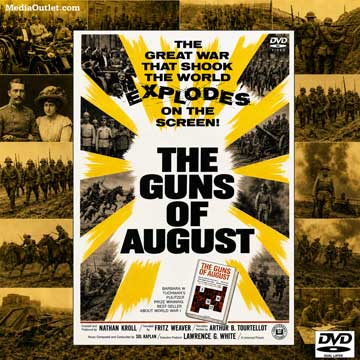
August 1, 1914: Causes Of The European Civil War (Events Leading To The European Civil War): Causes Of World War I (Events Leading To World War I): The Guns Of August: The July Crisis: The German Empire's Declaration Of War On The Russian Empire: -- Following on the July 28, 1914 declaration of war by Austria-Hungary on Serbia, Austria-Hungary's ally, the German Empire, declares war on the Russian Empire, deepening the opening of World War I. The Swiss Army mobilizes because of World War I, but Switzerland escaped invasion in the war, due to Swiss General Ulrich Wille's 1912 war games having convinced visiting European heads of state, particularly Kaiser Wilhelm II, of the efficacy and determination of Swiss defences. The assassination of Austrian Archduke Ferdinand on June 28, 1914 led to a month of diplomatic manoeuvring between Austria-Hungary, Germany, Russia, France and Britain, called the July Crisis. Austria-Hungary correctly believed that Serbian officials (especially the officers of the Black Hand) were involved in the plot to murder the Archduke, and wanted to finally end Serbian interference in Bosnia. On July 23, Austria-Hungary delivered to Serbia the July Ultimatum, a series of ten demands that were made intentionally unacceptable, in an effort to provoke a war with Serbia. Serbia decreed general mobilisation on the 25th. Serbia accepted all of the terms of the ultimatum except for article six, which demanded that Austrian delegates be allowed in Serbia for the purpose of participation in the investigation into the assassination. Following this, Austria broke off diplomatic relations with Serbia and, the next day, ordered a partial mobilisation. Finally, on July 28, 1914, Austria-Hungary declared war on Serbia. On 29 July, Russia, in support of Serbia, declared partial mobilisation against Austria-Hungary. On the 30th, Russia ordered general mobilisation. German Chancellor Bethmann-Hollweg waited until the 31st for an appropriate response, when Germany declared a "state of danger of war". Kaiser Wilhelm II asked his cousin, Tsar Nicolas II, to suspend the Russian general mobilisation. When he refused, Germany issued an ultimatum demanding its mobilisation be stopped, and a commitment not to support Serbia. Another was sent to France, asking her not to support Russia if it were to come to the defence of Serbia. On August 1, after the Russian response, Germany mobilised and declared war on Russia. This also led to the general mobilisation in Austria-Hungary on August 4. The German government issued demands to France that it remain neutral as they had to decide which deployment plan to implement, it being difficult if not impossible to change the deployment whilst it was underway. The modified German Schlieffen Plan, Aufmarsch II West, would deploy 80% of the army in the west, and Aufmarsch I Ost and Aufmarsch II Ost would deploy 60% in the west and 40% in the east as this was the maximum that the East Prussian railway infrastructure could carry. The French did not respond, but sent a mixed message by ordering their troops to withdraw 10 km (6 mi) from the border to avoid any incidents, and at the same time ordered the mobilisation of her reserves. Germany responded by mobilising its own reserves and implementing Aufmarsch II West. On August 1 Wilhelm ordered General Moltke to "march the whole of the _ army to the East" after he had been wrongly informed that the British would remain neutral as long as France was not attacked. The General convinced the Kaiser that improvising the redeployment of a million men was unthinkable and that making it possible for the French to attack the Germans "in the rear" might prove disastrous. Yet Wilhelm insisted that the German army should not march into Luxembourg until he received a telegram sent by his cousin George V, who made it clear that there had been a misunderstanding. Eventually the Kaiser told Moltke, "Now you can do what you want." Germany attacked Luxembourg on 2 August, and on 3 August declared war on France. On August 4, after Belgium refused to permit German troops to cross its borders into France, Germany declared war on Belgium as well. Britain declared war on Germany at 19:00 UTC on August 4, 1914 (effective from 11 pm), following an "unsatisfactory reply" to the British ultimatum that Belgium must be kept neutral. On Sale Until Midnight Tonight PT! https://store.earthstation1.com/the-guns-of-august-dvd-1964-world-war-i-movie-documen1964.html
Today's
Today's EarthStation1.com 15% (Or More!) Off Commemorative Memorial Title:
Napoleon's Last Battle: The Memorial Of Saint Helena MP4 Download
DVD
Today, August 1, 2026
August 1, 1798: The Age Of Enlightenment (The Enlightenment, The Age Of Reason): The Age Of Revolution: The Atlantic Revolutions: The French Revolution: The French Revolutionary And Napoleonic Wars (The Great French War) (The French Revolutionary Wars, The Napoleonic Wars): The Napoleonic Wars: The French Invasion Of Egypt And Syria: The Mediterranean Campaign Of 1798: The Battle Of The Nile (The Battle Of Aboukir Bay [French: Bataille d'Aboukir]): -- A British Royal Navy fleet led by Rear-Admiral Sir Horatio Nelson begins the major three-day naval battle of The Battle Of The Nile in an unusual night action when it sails towards the French Navy fleet led by Vice-Admiral Francois-Paul Brueys d'Aigalliers sailing towards them in Aboukir Bay (modern Abu Qir Bay) on the Mediterranean coast off the Nile Delta of Egypt, provoking at 18:20 the leading French ships of the line Guerrier and Conquerant to open fire upon the British ships of the line Goliath and Zealous who were rapidly bearing down on them. By the next day, the British fleet decisively defeated the French Republic Navy fleet, the climax of a naval campaign that had ranged across the Mediterranean during the previous three months as a large French convoy sailed from Toulon to Alexandria carrying an expeditionary force under General Napoleon Bonaparte. Bonaparte sought to invade Egypt as the first step in a campaign against British India, part of a greater effort to drive Britain out of the French Revolutionary Wars. As Bonaparte's fleet crossed the Mediterranean, it was pursued by a British force under Nelson who had been sent from the British fleet in the Tagus to learn the purpose of the French expedition and to defeat it. He chased the French for more than two months, on several occasions missing them only by a matter of hours. Bonaparte was aware of Nelson's pursuit and enforced absolute secrecy about his destination. He was able to capture Malta and then land in Egypt without interception by the British naval forces. With the French army ashore, the French fleet anchored in Aboukir Bay, 20 miles (32 km) northeast of Alexandria. Commander Vice-Admiral Francois-Paul Brueys d'Aigalliers believed that he had established a formidable defensive position. The British fleet arrived off Egypt on 1 August and discovered Brueys's dispositions, and Nelson ordered an immediate attack. His ships advanced on the French line and split into two divisions as they approached. One cut across the head of the line and passed between the anchored French and the shore, while the other engaged the seaward side of the French fleet. Trapped in a crossfire, the leading French warships were battered into surrender during a fierce three-hour battle, while the centre succeeded in repelling the initial British attack. As British reinforcements arrived, the centre came under renewed assault and, at 22:00, the French flagship Orient exploded. The rear division of the French fleet attempted to break out of the bay, with Brueys dead and his vanguard and centre defeated, but only two ships of the line and two frigates escaped from a total of 17 ships engaged. The battle reversed the strategic situation between the two nations' forces in the Mediterranean and entrenched the Royal Navy in the dominant position that it retained for the rest of the war. It also encouraged other European countries to turn against France, and was a factor in the outbreak of the War of the Second Coalition. Bonaparte's army was trapped in Egypt, and Royal Navy dominance off the Syrian coast contributed significantly to the French defeat at the Siege of Acre in 1799 which preceded Bonaparte's return to Europe. Nelson had been wounded in the battle, and he was proclaimed a hero across Europe and was subsequently made Baron Nelson-although he was privately dissatisfied with his rewards. His captains were also highly praised and went on to form the nucleus of the legendary Nelson's Band of Brothers. The legend of the battle has remained prominent in the popular consciousness, with perhaps the best-known representation being Felicia Hemans' 1826 poem Casabianca. https://store.earthstation1.com/napoleon39s-last-battle-the-memorial-of-saint-helena-mp4-download-394.html
Today's
EarthStation1.com 15% (Or More!) Off Commemorative Memorial Title:
Chairman Mao Tse-Tung aka Mao Zedong Documentaries DVD, Download,
USB
Today, August 1, 2026
August 1, 1966: Maoism (Mao Zedong Thought): The Cultural Revolution (CR, The Great Proletarian Cultural Revolution): Politburos: Politburos Of The Chinese Communist Party: Central Committees: Central Committees Of The Chinese Communist Party: The 8th Central Committee Of The Chinese Communist Party: Plenums: Plenums Of The Chinese Communist Party: Plenums Of The 8th Central Committee Of The Chinese Communist Party: -- The Eleventh Plenum (a meeting of a deliberative assembly in which all members are present, as contrasted with a quorum) Of The Eighth Central Committee hastily convenes some ten weeks after the beginning of the Cultural Revolution in order to advance Mao Zedong's now decidedly radical agenda, with the result that the purges of intellectuals and imperialists within the leadership of the Chinese government and the Chinese Communist Party apparatus becomes official Chinese policy. At the plenum, Party Chairman Mao showed outright disdain for State President Liu Shaoqi, repeatedly interrupting Liu as he delivered his opening day speech. For several days, Mao repeatedly insinuated that the Party's leadership had contravened his revolutionary vision. Mao's line of thinking received a lukewarm reception from the conference attendees. Sensing that the largely obstructive party elite was unwilling to fully embrace his revolutionary ideology, Mao went on the offensive. On July 28, Red Guard representatives had written to Mao, calling for rebellion and upheaval to safeguard the revolution. Mao responded to the letters by writing his own big-character poster entitled "Bombard the Headquarters", rallying people to target the "command centre (i.e., Headquarters) of counterrevolution". Mao wrote that despite having undergone a Communist revolution, a "bourgeois" elite was still thriving in "positions of authority" in the government and Communist Party. Although no names were mentioned, this provocative statement by Mao has been interpreted as a direct indictment of the party establishment under Liu Shaoqi and Deng Xiaoping-the purported "bourgeois headquarters" of China. The personnel changes at the Plenum reflected a radical re-design of the party's hierarchy to suit this new ideological landscape. Liu and Deng kept their seats on the Politburo Standing Committee but were in fact sidelined from day-to-day party affairs. Lin Biao was elevated to become the Party's number-two figure; Liu Shaoqi's rank went from second to eighth, and was no longer Mao's heir apparent. Coinciding with the top leadership being thrown out of positions of power was the thorough undoing of the entire national bureaucracy of the Communist Party. The extensive Organization Department, in charge of party personnel, essentially ceased to exist. The Cultural Revolution Group (CRG), Mao's ideological 'Praetorian Guard', was catapulted to prominence to propagate his ideology and rally popular support. The top officials in the Propaganda Department were sacked, with many of its functions folding into the CRG. On Sale Until Midnight Tonight PT! https://store.earthstation1.com/mao-tse-tung-dvd-portraits-of-power-cbs-biography-documentaries.html
Today's
EarthStation1.com 15% (Or More!) Off Commemorative Memorial Title:
America Held Hostage: As It Happened The Iran Hostage Crisis MP4
DVD
Today, August 1, 2026
August 1, 1961 The Aftermath Of World War II: The Cold War: The Cold War: The Cold War (1953-1962): Intelligence And Security Agencies: The United States Military (The United States Armed Forces): Military Intelligence Of The United States: The Defense Intelligence Agency (DIA): -- U.S. Defense Secretary Robert McNamara orders the creation of the Defense Intelligence Agency (DIA), the nation's first centralized military espionage organization. The DIA is an intelligence agency and combat support agency of the United States Department of Defense (DOD) specializing in military intelligence. A component of the Department of Defense and the Intelligence Community (IC), DIA informs national civilian and defense policymakers about the military intentions and capabilities of foreign governments and non-state actors. It also provides intelligence assistance, integration and coordination across uniformed military service intelligence components, which remain structurally separate from DIA. The agency's role encompasses the collection and analysis of military-related foreign political, economic, industrial, geographic, and medical and health intelligence. DIA produces approximately one-quarter of all intelligence content that goes into the President's Daily Brief. DIA's intelligence operations extend beyond the zones of combat, and approximately half of its employees serve overseas at hundreds of locations and in U.S. embassies in 140 countries. The agency specializes in the collection and analysis of human-source intelligence (HUMINT), both overt and clandestine, while also handling U.S. military-diplomatic relations abroad. DIA concurrently serves as the national manager for the highly technical measurement and signature intelligence (MASINT) and as the Defense Department manager for counterintelligence programs. The agency has no law enforcement authority, contrary to occasional portrayals in American popular culture. DIA is a national-level intelligence organization which does not belong to a single military element or within the traditional chain of command, instead answering to the secretary of defense directly through the under secretary of defense for intelligence. Around 2008, three-quarters of the agency's 17,000 employees were career civilians who were experts in various fields of defense and military interest or application; and although no military background is required, 48% of agency employees have some past military service. DIA has a tradition of marking unclassified deaths of its employees on the organization's Memorial Wall. DIA was involved in U.S. intelligence efforts throughout the Cold War and rapidly expanded, both in size and scope, after the September 11 attacks. Because of the sensitive nature of its work, the spy organization has been embroiled in numerous controversies, including those related to its intelligence-gathering activities, to its role in torture, as well as to attempts to expand its activities on U.S. soil. On Sale Until Midnight Tonight PT! https://store.earthstation1.com/america-held-hostage-as-it-happened-the-iran-hostage-crisis-mp4-dv4.html
Today's
EarthStation1.com 15% (Or More!) Off Commemorative Memorial Title:
Air Combat Aerial Warfare Documentary Series DVD, Download, USB
Drive
Today, August 1, 2026
August 1, 1907: #BOTD: #HBD! Aviation: The History Of Aviation: The History Of Military Aviation: The Aeronautical Division, U.S. Signal Corps (August 1, 1907 - July 18, 1914): -- The first heavier-than-air military aviation organization in history is created as a part of the U.S. Army by the U.S. War Department, who names it The Aeronautical Division, U.S. Signal Corps, which through a succession of changes of organization, titles, and missions advanced toward eventual independence 40 years later as the U.S. Air Force. The Aeronautical Division, Signal Corps procured the first powered military aircraft in 1909, created schools to train its aviators, and initiated a rating system for pilot qualifications. It organized and deployed the first permanent American aviation unit, the 1st Aero Squadron, in 1913. The Aeronautical Division trained 51 officers and 2 enlisted men as pilots, and incurred 13 fatalities in air crashes. During this period, the Aeronautical Division had 29 factory-built aircraft in its inventory, built a 30th from spare parts, and leased a civilian airplane for a short period in 1911. Following statutory authorization of an Aviation Section in the Signal Corps by the United States Congress in 1914, the Aeronautical Division continued as the primary organizational component of the section until April 1918, when its inefficiency in mobilizing for World War I caused the War Department to replace it with an organization independent of the Signal Corps that eventually became the foundation of the Army's Air Service. On Sale Until Midnight Tonight PT! https://store.earthstation1.com/air-combat-all-13-aerial-warfare-history-tv-shows-collecti13.html
Today's
EarthStation1.com 15% (Or More!) Off Commemorative Memorial Title:
War Jets: Air Superiority: US/Soviet Fighter Match-Up DVD, MP4,
USB
Today, August 1, 2026
August 1, 1957: The Cold War: Air Defense (Anti-Aircraft Defense): Space Defense: North American Air Defense (North American Anti-Aircraft Defense): North American Space Defense: Space Forces: Space Commands: Combined Operations: United States-Canada Combined Operations: The North American Air Defense Command (NORAD) (As of March 1981 named The North American Aerospace Defense Command [NORAD]): -- NORAD is formed by the United States and Canada as a combined operations organization tho provide aerospace warning, air sovereignty, and protection for Northern America. NORAD describes itself as providing aerospace defence, which "includes the detection, validation, and warning of attack against North America whether by aircraft, missiles, or space vehicles." Headquarters for NORAD and the NORAD/United States Northern Command (USNORTHCOM) center are located at Peterson Air Force Base in El Paso County, near Colorado Springs, Colorado. The nearby Cheyenne Mountain Complex has the Alternate Command Center. The NORAD commander and deputy commander (CINCNORAD) are, respectively, a United States four-star general or equivalent and a Canadian three-star general or equivalent. As a publicity move on December 24, 1955, NORAD's predecessor, the Continental Air Defense Command (CONAD), informed the press that CONAD was tracking Santa Claus' sleigh, adding that "CONAD, Army, Navy and Marine Air Forces will continue to track and guard Santa and his sleigh on his trip to and from the U.S. against possible attack from those who do not believe in Christmas", and a Christmas Eve tradition was born, known as the "NORAD Tracks Santa" program. Every year on Christmas Eve, "NORAD Tracks Santa" purports to track Santa Claus as he leaves the North Pole and delivers presents to children around the world. Today, NORAD relies on volunteers to make the program possible. On Sale Until Midnight Tonight PT! https://store.earthstation1.com/war-jets-air-superiority-us-vs-soviet-fighter-planes-dvd-mp4-us4.html
Today's
EarthStation1.com 15% (Or More!) Off Commemorative Memorial Title:
Eye Of The Dictator: Nazi Newereels Feature Documentary DVD, MP4,
USB
Today, August 1, 2026
August 1, 1936: The Olympic Games (The Olympics): The 1936 Summer Olympics: (German: Olympische Sommerspiele 1936)) (The Games Of The XI Olympiad (German: Spiele Der XI. Olympiade), Berlin 1936): -- The 1936 Summer Olympics opens in Berlin with a ceremony presided over by Adolf Hitler. The 1936 Summer Olympics (German: Olympische Sommerspiele 1936), officially known as the Games of the XI Olympiad (German: Spiele der XI. Olympiade), was an international multi-sport event held in 1936 in Berlin, Germany. Berlin won the bid to host the Games over Barcelona, Spain, on April 26, 1931, at the 29th IOC Session in Barcelona. It marked the second and most recent time the International Olympic Committee gathered to vote in a city that was bidding to host those Games. To outdo the Los Angeles games of 1932, Reich Chancellor Adolf Hitler had a new 100,000-seat track and field stadium built, as well as six gymnasiums and many other smaller arenas. The games were the first to be televised, and radio broadcasts reached 41 countries. The Fernsehsender Paul Nipkow (TV Station Paul Nipkow) in Berlin, Germany, the first public television station in the world (named for the inventor of the Nipkow disk, a mechanical rotating image scanning scanning disk device thatwas a fundamental component in mechanical television through the 1920s and 1930s), broadcast the games for Deutscher Fernseh-Rundfunk (German Television Broadcasting). The station was receivable only in and around Berlin but became very popular during the Berlin Olympics, when about 160,000 viewers saw them on a few private televisions and in many public television parlours. Deutscher Fernseh-Rundfunk used an early electro-mechanical system, based around the intermediate film technique (a television process in which motion picture film was processed almost immediately after it was exposed in a camera, then scanned by a television scanner, and transmitted over the air), combined with the the Nipkow disk, broadcasting at at a resolution of 180 lines. Filmmaker Leni Riefenstahl was commissioned by the German Olympic Committee to film the Games for 7M USD. Her film, titled Olympia, pioneered many of the techniques now common in the filming of sports. Hitler saw the Games as an opportunity to promote his government and ideals of racial supremacy and antisemitism, and the official Nazi party paper, the Volkischer Beobachter, wrote in the strongest terms that Jews should not be allowed to participate in the Games. German Jewish athletes were barred or prevented from taking part by a variety of methods, although some women swimmers from the Jewish sports club, Hakoah Vienna, did take part. Jewish athletes from other countries seem to have been side-lined in order not to offend the Nazi regime. Total ticket revenues were 7.5 million Reichsmark, generating a profit of over one million RM. The official budget did not include outlays by the city of Berlin (which issued an itemized report detailing its costs of 16.5 million RM) or outlays of the German national government (which did not make its costs public, but is estimated to have spent 30M USD. Jesse Owens won four gold medals in the sprint and long jump events and became the most successful athlete to compete in Berlin while Germany was the most successful country overall with 89 medals total, with the United States coming in second with 56 medals. These were the final Olympics under the presidency of Henri de Baillet-Latour and the final Olympic Games for 12 years due to the disruption of the Second World War. The next Olympic Games were held in 1948 (the Winter in Switzerland and then the Summer in London). (Sell Eye Of The Dictator ) On Sale Until Midnight Tonight PT! https://store.earthstation1.com/eye-of-the-dictator-dvd-third-reich-propaganda-films.html
Today's
EarthStation1.com 15% (Or More!) Off Commemorative Memorial Title:
The Last Chapter: The End Of Jewish Life In Poland DVD, MP4, USB
Drive
Today, August 1, 2026
August 1, 1944: The European Civil War: World War II: The Second European War (The European Theater Of World War II): The Eastern Front Of World War II: The Polish Resistance Movement In World War II: Operation Tempest (Polish: Akcja Burza, "Operation Storm"): The Warsaw Uprising: (Polish: Powstanie Warszawskie; German: Warschauer Aufstand) (The August Uprising [Polish: Powstanie Sierpniowe]): -- The Warsaw Uprising begins as the Polish Home Army, numbering about 40,000 Polish patriots, starts shooting at Germans in the streets. The Nazis then sent eight divisions to battle the Poles, who had hoped for, but did not receive, assistance from the Allies. Two months later, the rebellion was quashed. Not to be confused with the Warsaw Ghetto Uprising or a Battle Of Warsaw, the Warsaw Uprising was a major World War II operation by the Polish underground resistance, led by the Home Army (Polish: Armia Krajowa), to liberate Warsaw from German occupation. The uprising was timed to coincide with the retreat of the German forces from Poland ahead of the Soviet advance. While approaching the eastern suburbs of the city, the Red Army temporarily halted combat operations, enabling the Germans to regroup and defeat the Polish resistance and to raze the city in reprisal. The Uprising was fought for 63 days with little outside support. It was the single largest military effort taken by any European resistance movement during World War II. The Uprising began on 1 August 1944 as part of a nationwide Operation Tempest, launched at the time of the Soviet Lublin-Brest Offensive. The main Polish objectives were to drive the Germans out of Warsaw while helping the Allies defeat Germany. An additional, political goal of the Polish Underground State was to liberate Poland's capital and assert Polish sovereignty before the Soviet-backed Polish Committee of National Liberation could assume control. Other immediate causes included a threat of mass German round-ups of able-bodied Poles for "evacuation"; calls by Radio Moscow's Polish Service for uprising; and an emotional Polish desire for justice and revenge against the enemy after five years of German occupation. Initially, the Poles established control over most of central Warsaw, but the Soviets ignored Polish attempts to maintain radio contact with them and did not advance beyond the city limits. Intense street fighting between the Germans and Poles continued. By 14 September, the eastern bank of the Vistula River opposite the Polish resistance positions was taken over by the Polish troops fighting under the Soviet command; 1,200 men made it across the river, but they were not reinforced by the Red Army. This, and the lack of air support from the Soviet base five-minute flying time away, led to allegations that Joseph Stalin tactically halted his forces to let the operation fail, and to allow the Polish resistance to be crushed. Arthur Koestler called the Soviet attitude "one of the major infamies of this war which will rank for the future historian on the same ethical level with Lidice." Winston Churchill pleaded with Stalin and Franklin D. Roosevelt to help Britain's Polish allies, to no avail. Then, without Soviet air clearance, Churchill sent over 200 low-level supply drops by the Royal Air Force, the South African Air Force, and the Polish Air Force under British High Command, in an operation known as the Warsaw Airlift. Later, after gaining Soviet air clearance, the U.S. Army Air Force sent one high-level mass airdrop as part of Operation Frantic. Although the exact number of casualties remains unknown, it is estimated that about 16,000 members of the Polish resistance were killed and about 6,000 badly wounded. In addition, between 150,000 and 200,000 Polish civilians died, mostly from mass executions. Jews being harboured by Poles were exposed by German house-to-house clearances and mass evictions of entire neighbourhoods. German casualties totalled over 8,000 soldiers killed and missing, and 9,000 wounded. During the urban combat approximately 25% of Warsaw's buildings were destroyed. Following the surrender of Polish forces, German troops systematically levelled another 35% of the city block by block. Together with earlier damage suffered in the 1939 Invasion Of Poland and the Warsaw Ghetto Uprising in 1943, over 85% of the city was destroyed by January 1945, when the course of the events in the Eastern Front forced the Germans to abandon the city. On Sale Until Midnight Tonight PT! https://store.earthstation1.com/the-last-chapter-the-end-of-jewish-life-in-poland-dvd-mp3-us3.html
Today's
EarthStation1.com 15% (Or More!) Off Commemorative Memorial Title:
The Diary Of Anne Frank TV Series DVD, Video Download, USB Drive
Today, August 1, 2026
August 1, 1944: The European Civil War: World War II: The Second European War (The European Theater Of World War II): The Holocaust (Shoah): The Holocaust In The Netherlands: -- Anne Frank pens her last entry into her diary: "[I] keep on trying to find a way of becoming what I would like to be, and what I could be, if...there weren't any other people living in the world." Three days later, Anne and her family were arrested and sent to Nazi concentration camps. Anne died at Bergen-Belsen concentration camp in 1945 at age 15. On June 25, 1947, The Diary Of A Young Girl, better known as The Diary of Anne Frank, was published by Contact Publishing in Amsterdam. It is a book of the writings from the Dutch language diary kept by Anne Frank while she was in hiding for two years with her family during the Nazi occupation of the Netherlands. The family was apprehended in 1944, and Anne Frank died of typhus in the Bergen-Belsen concentration camp in 1945. The diary was retrieved by Miep Gies, who gave it to Anne's father, Otto Frank, the family's only known survivor, just after the war was over. The diary has since been published in more than 60 languages. The diary received widespread critical and popular attention on the appearance of its English language translation Anne Frank: The Diary of a Young Girl by Doubleday and Company (United States) and Valentine Mitchell (United Kingdom) in 1952. Its popularity inspired the 1955 play The Diary of Anne Frank by the screenwriters Frances Goodrich and Albert Hackett, which they adapted for the screen for the 1959 movie version. The book is included in several lists of the top books of the 20th century. On Sale Until Midnight Tonight PT! https://store.earthstation1.com/the-diary-of-anne-frank-dvd-complete-4-part-tv-miniserie4.html
Today's
EarthStation1.com 15% (Or More!) Off Commemorative Memorial Title:
The Ploesti Raid: WWII's Operation Tidal Wave MP4 Video Download
DVD
Today, August 1, 2026
August 1, 1943: The European Civil War: World War II: The Second European War (The European Theater Of World War II): The Eastern Front Of World War II: Western Allied Campaign In Romania: Air Warfare Of World War II: Strategic Bombing During World War II: The Allied Oil Campaign Of World War II: European Air Operations During The Battle Of Europe: Operation Tidal Wave (The Ploesti Raid, Black Sunday): -- Bombers of the United States Army Air Forces (USAAF) based in Libya and Southern Italy launch an ill-fated air raid on nine Romanian oil refineries around Ploesti, Romania. It was a strategic bombing mission and part of the "oil campaign" to deny petroleum-based fuel to the Axis. The mission resulted in "no curtailment of overall product output". This mission was one of the costliest for the USAAF in the European Theater, with 53 aircraft and 660 aircrewmen lost. It was the second-worst loss ever suffered by the USAAF on a single mission and its date was later referred to as "Black Sunday". Five Medals of Honor and numerous Distinguished Service Crosses were awarded to Operation Tidal Wave crew members. On Sale Until Midnight Tonight PT! https://store.earthstation1.com/ploesti-raid-operation-tidal-wave-wwii-dvd.html
Today's
EarthStation1.com 15% (Or More!) Off Commemorative Memorial Title:
America: The Way We Were: The Home Front 1940-1945 DVD, Download,
USB
Today, August 1, 2026
August 1-2, 1943: World War II: The Home Front During World War II: The United States Home Front During World War II: Race Riots: Race Riots In The United States: The Harlem Riot Of 1943: -- A two-day riot breaks out in Harlem, New York City after a white police officer, James Collins, shot and wounded Robert Bandy, an African American soldier; and rumors circulated that the soldier had been killed. The riot was chiefly directed by Black residents against white-owned property in Harlem. It was one of five riots in the nation that year related to Black and white tensions during World War II. The others took place in Detroit; Beaumont, Texas; Mobile, Alabama; and Los Angeles. In Harlem, Bandy had witnessed a Black woman's arrest for disorderly conduct in a hotel and sought to have her released. According to the police, Bandy hit the officer, who shot the soldier as he was trying to flee from the scene. A crowd of about 3,000 people gathered at police headquarters after a smaller crowd had followed Bandy and the officer to a hospital for treatment. When someone in the crowd at police headquarters incorrectly stated that Bandy had been killed, a riot ensued in the community that lasted for two days and resulted in six deaths and hundreds injured, with nearly 600 arrests. The riot had a pattern mostly of vandalism, theft, and property destruction of white-owned businesses in Harlem, resulting in monetary damages, rather than attacks on persons. New York City Mayor Fiorello H. La Guardia ultimately restored order in the borough on August 2 with the recruitment of several thousand officers and volunteer forces to contain the rioters. City units cleaned up and repaired buildings. The mayor also supplied food and goods afterward to compensate for the closed businesses. The underlying causes of the riot stemmed from resentment among Black residents of Harlem of the disparity between the vaunted values of American democracy and the social and economic conditions they were forced to live under, including brutality and discriminatory treatment by the mostly white city police force. They resented the segregation of Black troops serving with the United States, and wartime shortages created more difficult conditions in Harlem housing and supplies. African Americans suffered discriminatory practices in civil and private employment, and city services, which created tension as they tried to improve their lives. Bandy symbolized the Black soldiers who were segregated in the Army, even as the United States promoted the national fight for 'freedom.' Collins represented the white discrimination and suppression Black residents had to deal with on a daily basis. The riot became a subject of art and literature: it inspired the "theatrical climax" of Ralph Ellison's novel Invisible Man, winner of the 1953 National Book Award, it frames the events recounted in James Baldwin's memoirs Notes of a Native Son, and it appears in artist William Johnson's painting Moon Over Harlem. On Sale Until Midnight Tonight PT! https://store.earthstation1.com/america-the-way-we-were-the-home-front-19401945-life-and-cu19401945.html
Today's
EarthStation1.com 15% (Or More!) Off Commemorative Memorial Title:
Jerash: Pompeii Of The East Greco-Roman Archaeology DVD MP4
Download
Today, August 1, 2026
August X, 2015: Archaelogy (Archeology): Ancient Jordan: Jerash: -- An archaeological excavation team from the University of Jordan unearthed two human skulls that date back to the Neolithic period (7500-5500 BC) at a site in Jerash. This forms solid evidence of inhabitance of Jordan in that period, especially in connection with the existence of 'Ain Ghazal Neolithic settlement in Amman. The importance of the discovery lies in the rarity of the skulls, as archaeologists estimate that a maximum of 12 sites across the world contain similar human remains. Archaeologists have found ruins of settlements in Jerash dating back as far as the Neolithic Age. On Sale Until Midnight Tonight PT! https://store.earthstation1.com/jerash-pompeii-of-the-east-grecoroman-archaeology-dvd-mp4-downloa4.html
Today's
EarthStation1.com 15% (Or More!) Off Commemorative Memorial Title:
Antony and Cleopatra (1991) DVD, MP4 Video Download, USB Flash
Drive
Today, August 1, 2026
August 1, 30 BC: Rome: Ancient Rome: Roman Civil Wars And Revolts: The Roman Republic: The Crisis Of The Roman Republic: Civil Wars Of The Roman Republic: The War Of Actium (The Final War Of The Roman Republic): The Battle Of Alexandria (The Final Battle Of The Final War Of The Roman Republic): -- #DOTD: Mark Antony #dies when he commits suicide after hearing incorrectly that Cleopatra had done so. The tomb of Antony and Cleopatra is in an as yet undiscovered burial crypt assumed to be located in Alexandria, Egypt. According to historians Suetonius and Plutarch, the Roman leader Octavian permitted their burial together after he had defeated them. Their surviving children were taken to Rome, to be raised as Roman citizens. The Egyptian Ministry of Tourism and Antiquities believes that it is in or near a temple of Taposiris Magna, southwest of Alexandria. Octavian, later known as Augustus, entered Alexandria, Egypt after their death, bringing it under the control of the Roman Republic. The day prior, July 31, 30 BC, Mark Antony achieved a minor victory over Octavian's forces, but most of his army subsequently deserted, leading to his suicide the following day. In early August, Octavian launched a second, ultimately successful, invasion of Egypt. The Final War of the Roman Republic, also known as Antony's Civil War or The War between Antony and Octavian, was the last of the Roman Civil Wars of the Roman Republic, fought between Mark Antony (assisted by Cleopatra) and Octavian. After the Roman Senate declared war on the Egyptian queen Cleopatra, Antony, her lover and ally, betrayed the Roman government and joined the war on Cleopatra's side. After the decisive victory for Octavian at the Battle of Actium on 2 September 31 BC, Cleopatra and Antony withdrew to Alexandria, where Octavian besieged the city until both Antony and Cleopatra committed suicide. Following the end of the war, Octavian brought peace to the Roman state that had been plagued by a century of civil wars. Octavian became the most powerful man in the Roman world and the Senate bestowed upon him the name of Augustus in 27 BC. Octavian, now Augustus, would be the first Roman Emperor and would transform the oligarchic/democratic Republic into the autocratic Roman Empire. The last Republican Civil War would mark the beginning of the Pax Romana, which remains the longest period of peace and stability that Europe has seen in recorded history. On Sale Until Midnight Tonight PT! https://store.earthstation1.com/antony-amp-cleopatra-samuel-barber39s-opera-shakespeare39s-words3939.html
Today's
EarthStation1.com 15% (Or More!) Off Commemorative Memorial Title:
Television: A History Of Broadcast TV DVD MP4 Download USB Drive
Today, August 1, 2026
August 1, 10 BC: #BOTD: #HBD! Claudius (Latin: Tiberius Claudius Caesar Augustus Germanicus), Roman emperor from 41 to 54 AD (d. October 13, 54) is #born Tiberius Claudius Caesar Augustus Germanicus in Lugdunum, Gaul (modern France). A member of the Julio-Claudian dynasty, he was the son of Drusus and Antonia Minor. He was born at Lugdunum in Gaul, the first (and until Trajan, only) Roman Emperor to be born outside Italy. Because he was afflicted with a limp and slight deafness due to sickness at a young age, his family ostracized him and excluded him from public office until his consulship, shared with his nephew Caligula in 37. Claudius' infirmity probably saved him from the fate of many other nobles during the purges of Tiberius's and Caligula's reigns; potential enemies did not see him as a serious threat. His survival led to his being declared Emperor by the Praetorian Guard after Caligula's assassination, at which point he was the last man of his family. Despite his lack of experience, Claudius proved to be an able and efficient administrator. He was also an ambitious builder, constructing many new roads, aqueducts, and canals across the Empire. During his reign the Empire began the conquest of Britain (if the earlier invasions of Britain by Caesar and Caligula's aborted attempts are not counted). Having a personal interest in law, he presided at public trials, and issued up to twenty edicts a day. He was seen as vulnerable throughout his reign, particularly by elements of the nobility. Claudius was constantly forced to shore up his position; this resulted in the deaths of many senators. These events damaged his reputation among the ancient writers, though more recent historians have revised this opinion. Many authors contend that he was murdered by his own wife. After his death in 54 AD (at age of 63), his grand-nephew, step-son, and adopted son Nero succeeded him as Emperor. His 13-year reign (slightly longer than Nero's) would not be surpassed by any successors until that of Domitian, who reigned for 15 years. He was a descendant of the Octavii Rufi (through Gaius Octavius), Julii Caesares (through Julia Minor and Julia Antonia), and the Claudii Nerones (through Nero Claudius Drusus). He was a step-grandson (through his father Drusus) and great-nephew (through his mother Antonia Minor) of Augustus. He was a nephew of Tiberius through his father, Tiberius' brother. Through his brother Germanicus, Claudius was an uncle of Caligula and a great-uncle of Nero. Claudius died after eating mushrooms poisoned by his wife, the Empress Agrippina. He is buried in The Mausoleum Of Augustus in Rome, Italy. Claudius looms large in modern literature, film and radio. The best known fictional representation of the Emperor Claudius was contained in the books I, Claudius and Claudius the God (published in 1934 and 1935, respectively) by Robert Graves, both written in the first-person to give the reader the impression that they are Claudius' autobiography. Graves employed a fictive artifice to suggest that they were recently discovered, genuine translations of Claudius' writings. Claudius' extant letters, speeches, and sayings were incorporated into the text (mostly in the second book, Claudius the God), to add authenticity. Graves's interpretation of the story owes much to the histories of Gaius Cornelius Tacitus, Plutarch and (especially) Suetonius (Lives of the Twelve Caesars). Graves said that after reading the accounts of Claudius by Suetonius and Tacitus "I knew there was a mistake somewhere, and that one day, I'd write the real story." Graves translated Suetonius before writing the novels. Graves claimed that after he read Suetonius, Claudius came to him in a dream one night and demanded that his real story be told. Graves also claimed that he made a deal with Claudius that he would write "the real story". provided the book covered the 4,000 Pounds Sterling that Graves needed to cover losses in a bad land deal; the first edition of the book raised 8,000 Pounds Sterling). The life of Claudius provided Graves with a way to write about the first four Emperors of Rome (Augustus, Tiberius, Caligula, and Claudius) from an intimate point of view. In addition, the real Claudius was a trained historian and is known to have written an autobiography (now lost) in eight books that covered the same time period. I, Claudius is a first-person narrative of Roman history from the reigns of Augustus to Caligula; Claudius the God is written as a later addition documenting Claudius' own reign. In 1937, director Josef von Sternberg attempted a film version of I, Claudius, with Charles Laughton as Claudius. However, the lead actress, Merle Oberon, suffered a near-fatal car accident and the movie was never finished. The surviving reels were featured in the BBC documentary The Epic That Never Was (1965). Graves's two books were the basis for a British television adaptation I, Claudius, produced by the BBC. The series starred Derek Jacobi as Claudius and was broadcast in 1976 on BBC2.It was a substantial critical success, and won several BAFTA awards. The series was later broadcast in the United States on Masterpiece Theatre in 1977. On Sale Until Midnight Tonight PT! https://store.earthstation1.com/television-1988-tv-documentary-series-8-shows-4-dual-laye198884.html
Today's
EarthStation1.com 15% (Or More!) Off Commemorative Memorial Title:
The Soviet-Afghan War DVD, MP4 Video Download, USB Flash Drive
Today, August 1, 2026
August 1, 1929: #BOTD: Hafizullah Amin, Afghan educator, communist politician during the cold war, Afghan People's Democratic Party General Secretary and 2nd President of Afghanistan (d. December 27, 1979) is #born in the Paghman district of Kabul and educated at Kabul University, after which he started his career as a teacher. After a few years in that occupation, he went to the United States to study. He would visit the United States a second time before moving permanently to Afghanistan, and starting his career in radical politics. He ran as a candidate in the 1965 parliamentary election but failed to secure a seat. Amin was the only Khalqist elected to parliament in the 1969 parliamentary election, thus increasing his standing within the party. He was one of the leading organizers of the Saur Revolution which overthrew the government of Mohammad Daoud Khan. In 1979 he named himself as president, prime minister, and chairman of the Khalq wing. He has been described as "ruthless" and a "radical Marxist". Amin's short-lived presidency was marked by controversies from beginning to end. He came to power by disposing of his predecessor Nur Muhammad Taraki and later ordering his death. Amin made attempts to win support from those who revolted against the communist regime which had begun under Taraki, but his government was unable to solve this problem. Many Afghans held Amin responsible for the regime's harshest measures, such as ordering thousands of executions. Thousands of people disappeared without trace during his time in office. The Soviet Union, which was dissatisfied with Amin, intervened in Afghanistan while invoking the Twenty-Year Treaty of Friendship between Afghanistan and the Soviet Union. Hafizullah Amin died when he was assassinated by the Soviets as part of Operation Storm-333 (Russian: Shtorm-333), a covert operation in which Soviet special forces stormed the Tajbeg Palace in Afghanistan with the deliberate intent of assassinating Amin. He is buried at The Tajbeg Palace Grounds. There are various accounts of how Amin died, and the exact details have never been confirmed, but it is believed he was killed either by a deliberate attack or died by a "random burst of fire", having ruled for slightly longer than three months. Tajbeg Palace was guarded by Afghan National Army. In the ensuing battle, Afghan armed forces suffered major losses. 30 Afghan palace guards and over 300 army guards were killed while 150 were captured. Amin's 11-year-old son died from shrapnel wounds. A total of 1,700 Afghan soldiers surrendered to Soviet troops and were taken as prisoners. The Soviets installed Babrak Karmal as Amin's successor. Several other government buildings were seized during the operation, including the Ministry of Interior building, the Internal Security (KHAD) building, and the General Staff building (Darul Aman Palace). Alpha Group veterans call this operation one of the most successful in the group's history. Declassified Russian documents show that the Soviet leadership believed that Hafizullah Amin had secret contacts with the US embassy and was probably a US agent. However, this assumption was later proven to be false. He is buried at The Tajbeg Palace Grounds in Kabul, Afghanistan. On Sale Until Midnight Tonight PT! https://store.earthstation1.com/the-sovietafghan-war-dvd-mp4-usb-driv4.html
Today's
EarthStation1.com 15% (Or More!) Off Commemorative Memorial Title:
The Fabulous Sixties with Peter Jennings TV Docuseries MP4 Or DVD
Set
Today, August 1, 2026
August 1, 1966: Crime: Crime In The United States: Murders: Mass Murders: The University Of Texas Tower Shooting(s): -- What at the time was the deadliest mass shooting by a lone gunman in U.S. history occurs when Charles Whitman, "The Texas Tower Sniper", after having used knives to kill his mother and his wife in their respective homes to spare them "the embarrassment" of what he was about to do, kills 16 people when at 11:48 a.m. he begins firing his Remington Model 700 6-mm bolt-action hunting rifle equipped with a Leupold M8-4X scope indiscriminately from the observation deck of The Main Building, known colloquially as "The Tower", of The University Of Texas At Austin, 231 feet (70 m) above the ground of the university, a rampage that lasted 96 minutes until Police Officer Ramiro Martinez, Police Officer Houston McCoy and civilian retired Air Force tail gunner Allen Crum reach Whitman, who died from gunshots from the police officers. He is buried at Hillcrest Memorial Park in West Palm Beach, Florida. It was the deadliest mass shooting by a lone gunman in American history until it was surpassed 18 years later by the 1984 San Ysidro McDonald's Massacre. It has been suggested that Whitman's violent impulses, with which he had been struggling for several years, were caused by a tumor found in the white matter above his amygdala, one of two almond-shaped clusters of nuclei located deep and medially within the temporal lobes of the brain, upon autopsy. After stabbing his mother and his wife to death the night before, Charles Whitman, a former Marine, took a cache of firearms and more than 700 rounds of ammunition to the observation deck atop the Main Building tower at the University of Texas at Austin. Over the next 96 minutes he shot and killed 14 people (including an unborn child) and injured 31 others. One final victim died from his injuries in 2001. At 6:45 p.m on July 31, 1966, At 6:45 p.m., Whitman began typing his suicide note, a portion of which read: "I do not quite understand what it is that compels me to type this letter. Perhaps it is to leave some vague reason for the actions I have recently performed. I do not really understand myself these days. I am supposed to be an average reasonable and intelligent young man. However, lately (I cannot recall when it started) I have been a victim of many unusual and irrational thoughts. These thoughts constantly recur, and it requires a tremendous mental effort to concentrate on useful and progressive tasks." In his note, he went on to request an autopsy be performed on his remains after he was dead to determine if there had been a discernible biological contributory cause for his actions and for his continuing and increasingly intense headaches. He also wrote that he had decided to kill both his mother and wife. Expressing uncertainty about his reasons, he nonetheless stated he did not believe his mother had "ever enjoyed life as she is entitled to", and that his wife had "been as fine a wife to me as any man could ever hope to have". Whitman further explained that he wanted to relieve both his wife and mother of the suffering of this world, and to save them the embarrassment of his actions. He did not mention planning the attack at the university. On Sale Until Midnight Tonight PT! https://store.earthstation1.com/decades-the-1960s-dvd-set-peter-jennings-tv-series-3-19603.html
Today's
EarthStation1.com 15% (Or More!) Off Commemorative Memorial Title:
The Charlie Chaplin Carnival, Festival & Cavalcade DVD, MP4,
USB Drive
Today, August 1, 2026
August X, 1938: Aesthetics: Performing Arts: Premieres: Film Premieres: American Film Premieres: -- Charlie Chaplin Cavalcade, a 1938 compilation film with sound of silent movie shorts Chaplin made with the Mutual Film Corporation, is released in the United States. Charlie Chaplin composed added a musical score and added sound effects to this compilation of his Mutual shorts "One A.M.", "The Rink", "The Pawnshop", and "The Floorwalker", and retitled them "Waiter And Skating Enthusiast / Pawnbroker's Assistant / Impecunious Customer". On Sale Until Midnight Tonight PT! https://store.earthstation1.com/the-charlie-chaplin-carnival-festival-and-cavalcade-dvd-12-sound-fil12.html
Today's
EarthStation1.com 15% (Or More!) Off Commemorative Memorial Title:
The March Of Time Newsreel Set 1933-46 All 3 TV Series DVD, MP4,
USB
Today, August 1, 2026
August 1, 1951: Grand Finales: Film Finales: American Film Finales: -- The March Of Time, American newsreel series sponsored by Time Inc. and shown in movie theaters from 1935 to 1951, concludes its theater run, which began on February 1, 1935. The March Of Time was based on a radio news series broadcast from 1931 to 1945. The voice of both series was Westbrook Van Voorhis. Produced and written by Louis de Rochemont and his brother Richard de Rochemont, The March of Time was recognized with an Academy Honorary Award in 1937. The March of Time organization also produced four feature films for theatrical release, and created documentary series for early television. Its first TV series, Crusade in Europe (1949), received a Peabody Award and one of the first Emmy Awards. On Sale Until Midnight Tonight PT! https://store.earthstation1.com/the-march-of-time-dvd-set-all-3-tv-series-19334631933467.html
Today's
EarthStation1.com 15% (Or More!) Off Commemorative Memorial Title:
The Hippie Temptation (1967) w/ Harry Reasoner DVD, MP4, USB Stick
Today, August 1, 2026
August 1, 1942: #BOTD: #HBD! Jerry Garcia, American singer, songwriter and guitarist, best known for his work as the lead guitarist and as a vocalist with the band Grateful Dead, which came to prominence during the counterculture era in the 1960s (d. August 9, 1995) is #born Jerome John Garcia in the Excelsior District of San Francisco, California to Jose Ramon "Joe" Garcia of Spanish descent and Ruth Marie "Bobbie" (nee Clifford) Garcia of Irish and Swedish descent; his parents named him after American musical theatre songwriter Jerome Kern. Although he disavowed the role, Garcia was viewed by many as the leader or "spokesman" of The Grateful Dead. One of its founders, Garcia performed with the Grateful Dead for their entire thirty-year career (1965-1995). His parents named him after American composer Jerome Kern. Garcia also founded and participated in a variety of side projects, including the Saunders-Garcia Band (with longtime friend Merl Saunders), the Jerry Garcia Band, Old and in the Way, the Garcia/Grisman acoustic duo, Legion of Mary, and the New Riders of the Purple Sage (which Garcia co-founded with John Dawson and David Nelson). He also released several solo albums, and contributed to a number of albums by other artists over the years as a session musician. He was well known for his distinctive guitar playing and was ranked 13th in Rolling Stone's "100 Greatest Guitarists of All Time" cover story. Later in life, Garcia was sometimes ill because of his diabetes, and in 1986, he went into a diabetic coma that nearly cost him his life. Although his overall health improved somewhat after that, he continued to struggle with obesity, smoking, and longstanding heroin and cocaine addictions. He was staying in a California drug rehabilitation facility when he died of a heart attack in August 1995 at the age of 53. Jerry Garcia died of a heart attack in his room at the the Betty Ford Center rehabilitation clinic in Forest Knolls, California, aged 53. Garcia had long struggled with drug addiction, weight problems, sleep apnea, heavy smoking, and diabetes -- all of which contributed to his physical decline. Lesh remarked that, upon hearing of Garcia's death, "I was struck numb. I had lost my oldest surviving friend, my brother." Garcia's funeral was held on August 12, at St. Stephen's Episcopal Church in Belvedere. It was attended by his family, the remaining Grateful Dead members, and their friends, including former pro basketball player Bill Walton and musician Bob Dylan. Deborah Koons barred two of Garcia's former wives from the ceremony. On August 13, about 25,000 people attended a municipally sanctioned public memorial at the Polo Fields of San Francisco's Golden Gate Park. Crowds produced hundreds of flowers, gifts, images, and a bagpipe rendition of "Amazing Grace" in remembrance. In the Haight, a single white rose was reportedly tied to a tree near the Dead's former Haight-Ashbury house, where a group of followers gathered to mourn. On the morning of April 4, 1996, after a total lunar eclipse earlier that day, Weir and Deborah Koons, accompanied by Sanjay Mishra, spread half of Garcia's ashes into the Ganges at the holy city of Rishikesh, India, a site sacred to Hindus. The remaining ashes were poured into the San Francisco Bay. Koons did not allow former wife Carolyn Garcia to attend the spreading of the ashes. On Sale Until Midnight Tonight PT! https://store.earthstation1.com/the-hippie-temptation-dvd-1967-harry-reasoner-cbs-tv-documen1967.html
Today's
EarthStation1.com 15% (Or More!) Off Commemorative Memorial Title:
I Want My Music TV! 1980s Music Videos DVD, MP4 Download, USB
Drive
Today, August 1, 2026
August 1, 1981: Aesthetics: Performing Arts: Premieres: Television Premieres: United States Television Premieres: -- MTV, the channel that originally aired music videos as guided by television personalities known as "video jockeys" (VJs), begins broadcasting in the United States and airs its first video, "Video Killed the Radio Star" by The Buggles. At first, MTV's main target demographic was young adults, but today it is primarily teenagers, particularly high school and college students. MTV has toned down its music video programming significantly in recent years, and its programming now consists mainly of original reality, comedy and drama programming and some off-network syndicated programs and films, with limited music video programming in off-peak time periods. On Sale Until Midnight Tonight PT! https://store.earthstation1.com/i-want-my-music-tv-dvd-late-1980s-vi1980.html
Today's
EarthStation1.com 15% (Or More!) Off Commemorative Memorial Title:
The American Adventure: TV History Series 1607-1876 DVD MP4 USB
Drive
Today, August 1, 2026
August 1, 1779: #BOTD: #HBD! Francis Scott Key, American lawyer, author, and amateur poet from Frederick, Maryland who is best known for writing a poem which later became the lyrics for the United States' national anthem, "The Star-Spangled Banner" (d. January 11, 1843) is #born in Frederick County, Maryland. During the War Of 1812, Key observed the British bombardment of Fort McHenry during The Battle Of Baltimore in Maryland in 1814. Key was inspired upon viewing the American flag still flying over the fort at dawn, and wrote the poem "Defence of Fort M'Henry", which was published a week later. The poem was adapted to the tune of the popular song "To Anacreon in Heaven." The song with Key's lyrics became known as "The Star-Spangled Banner," and slowly gained in popularity as an unofficial anthem over the years, finally achieving official status a century later under President Woodrow Wilson as the United States national anthem. Key was a lawyer in Maryland and Washington D.C. for four decades, and worked on important cases like the Burr conspiracy trial, and argued numerous times before the U.S. Supreme Court. Nominated for U.S. attorney by President Andrew Jackson, he served from 1833 to 1841. Key owned slaves from 1800 but freed them in the 1830s, paying one ex-slave as his farm foreman. Key publicly criticized slavery and gave free legal representation to some slaves seeking freedom, but also represented owners of runaway slaves as well. Representing both slaves and slave owners is emblematic of his complex relationship with slavery. As District Attorney, Key suppressed abolitionists and didn't support an immediate end to slavery. Instead he supported "recolonizing Africa" which meant sending freed slaves back to Africa. Key was a devout Episcopalian. He was also an author of poetry, and often wrote on religious themes. It has been speculated that the U.S. motto "In God We Trust" was adapted from a line in the fourth stanza of the "Star-Spangled Banner". Francis Scott Key died at the home of his daughter Elizabeth Howard in Baltimore from pleurisy at the age of 63. He was initially interred in Old Saint Paul's Cemetery in the vault of John Eager Howard but in 1866, his body was moved to his family plot in Frederick at Mount Olivet Cemetery. The Key Monument Association erected a memorial in 1898 and the remains of both Francis Scott Key and his wife, Mary Tayloe Lloyd, were placed in a crypt in the base of the monument. On Sale Until Midnight Tonight PT! https://store.earthstation1.com/the-american-adventure-series-us-1st-century-4-dv14.html
Today's
EarthStation1.com 15% (Or More!) Off Commemorative Memorial Title:
The Old Time Radio Drama MP3 MegaSet DVD, Audio Download, USB
Stick
Today, August 1, 2026
August 1, 1819: #BOTD: #HBD! Herman Melville, American novelist, short story writer, and poet of the American Renaissance period (d. September 28, 1891) is #born Herman Melvill (sic) in New York City, the third child of a prosperous merchant whose death in 1832 left the family in financial straits. Among his best-known works are Moby-Dick (1851), Typee (1846), a romanticized account of his experiences in Polynesia, and Billy Budd, Sailor, a posthumously published novella. Although his reputation was not high at the time of his death, the centennial of his birth in 1919 was the starting point of a Melville revival and Moby-Dick grew to be considered one of the great American novels. He took to sea in 1839 as a common sailor on a merchant ship and then on the whaler Acushnet but he jumped ship in the Marquesas Islands. Typee, his first book, and its sequel, Omoo (1847), were travel-adventures based on his encounters with the peoples of the island. Their success gave him the financial security to marry Elizabeth Shaw, the daughter of a prominent Boston family. Mardi (1849), a romance-adventure and his first book not based on his own experience, was not well received. Redburn (1849) and White Jacket (1850), both tales based on his experience as a well-born young man at sea, were given respectable reviews but did not sell well enough to support his expanding family. Melville's growing literary ambition showed in Moby-Dick (1851), which took nearly a year and a half to write, but it did not find an audience and critics scorned his psychological novel Pierre: or, The Ambiguities (1852). From 1853 to 1856, Melville published short fiction in magazines, including "Benito Cereno" and "Bartleby, the Scrivener". In 1857, he traveled to England, toured the Near East, and published his last work of prose, The Confidence-Man (1857). He moved to New York in 1863 to take a position as Customs Inspector. From that point, Melville focused his creative powers on poetry. Battle-Pieces and Aspects of the War (1866) was his poetic reflection on the moral questions of the American Civil War. In 1867, his eldest child Malcolm died at home from a self-inflicted gunshot. Melville's metaphysical epic Clarel: A Poem and Pilgrimage in the Holy Land was published in 1876. In 1886, his other son Stanwix died of apparent tuberculosis, and Melville retired. During his last years, he privately published two volumes of poetry, and left one volume unpublished. The novella Billy Budd was left unfinished at his death but was published posthumously in 1924. Herman Melville died in the morning in New York City aged 72 of what his death certificate declares as "cardiac dilation" (cardiovascular disease). He is interred in the Woodlawn Cemetery in the Bronx, New York City. There were few obituaries. The New York Times's initial death notice called his masterpiece "Mobie Dick" (sic), which later was erroneously taken to mean that he was unappreciated at his time of death. But there were some appreciations. The Times, for instance, published a substantial article of appreciation on October 2. The author said that thinking back to Melville's books that were so much read forty years earlier, there is "no difficulty determining why they were then read and talked about," but the difficulty is "to discover why they are read and talked about no longer." On Sale Until Midnight Tonight PT! https://store.earthstation1.com/the-old-time-radio-drama-mp3-dvd-megase3.html
Today's
EarthStation1.com 15% (Or More!) Off Commemorative Memorial Title:
Rock & Roll An Unruly History 10 Part TV Series MP4 Video
Download DVD
Today, August 1, 2026
August 1, 1960: #BOTD: #HBD! Chuck D, African American rapper, lyricist and songwriter, member of the rock supergroup Prophets Of Rage, best known as the leader and frontman of the hip hop group Public Enemy, which he co-founded in 1985 with Flavor Flav, is born Carlton Douglas Ridenhour on Long Island, New York. Chuck D has released several solo albums, most notably Autobiography of Mistachuck (1996). His work with Public Enemy helped create politically and socially conscious hip hop music in the mid-1980s. The Source ranked him at No. 12 on its list of the Top 50 Hip-Hop Lyricists of All Time. Chuck D has been nominated for six Grammys throughout his career, and has received the Grammy Lifetime Achievement Award as a member of Public Enemy. He was also inducted into the Rock and Roll Hall of Fame in 2013 as a member of Public Enemy. On Sale Until Midnight Tonight PT! https://store.earthstation1.com/rock-amp-roll-an-unruly-history-10-part-tv-series-mp4-video-download-104.html
Today's
EarthStation1.com 15% (Or More!) Off Commemorative Memorial Title:
The Gallant Breed: US Marine Chronicles + 2 Bonuses MP4 Download
DVD
Today, August 1, 2026
August 1, 1934: The United States: The History Of The United States: United States Expansionism: American Imperialism: The Banana Wars : The United States Occupation Of Haiti (July 28, 1915 - August 1, 1934): -- The United States ends a 20-year occupation of Haiti after President Franklin D. Roosevelt reaffirmed an August 1933 disengagement agreement. The last contingent of marines departed on August 15, 1934, after a formal transfer of authority to the American-created Gendarmerie of Haiti. The United States Occupation Of Haiti began on July 28, 1915 with The American Invasion Of Haiti, when United States President Woodrow Wilson ordered 340 United States Marines to occupy Port-Au-Prince. The invasion took place that same day, with 330 U.S. Marines landing at Port-Au-Prince, Haiti, after the National City Bank of New York convinced the President of the United States, Woodrow Wilson, to take control of Haiti's political and financial interests. The Secretary of the Navy instructed the invasion commander, Rear Admiral William Banks Caperton, to "protect American and foreign" interests. Wilson also wanted to rewrite the Haitian constitution, which banned foreign ownership of land, to replace it with one that guaranteed American financial control. To avoid public criticism, Wilson claimed the occupation was a mission to "re-establish peace and order ... [and] has nothing to do with any diplomatic negotiations of the past or the future," as disclosed by Rear Admiral Caperton. Only one Haitian soldier, Pierre Sully, tried to resist the invasion, and he was shot dead by the Marines. The United States Occupation Of Haiti (July 28, 1915 - August 1, 1934) took place following years of socioeconomic instability within Haiti that culminated with the lynching of President of Haiti Vilbrun Guillaume Sam by a mob angered by his decision to order the executions of political prisoners. The invasion and subsequent occupation was promoted by growing American business interests in Haiti, especially the National City Bank of New York, which had withheld funds from Haiti and paid rebels to destabilize the nation through the Bank of the Republic of Haiti with an aim at inducing American intervention. During the occupation, Haiti had three new presidents while the United States ruled as a military regime through martial law led by Marines and the Gendarmerie. Two major rebellions against the occupation occurred, resulting in several thousand Haitians killed, and numerous human rights violations - including torture and summary executions - by Marines and the Gendarmerie of Haiti. A corvee system of forced labor was used by the United States for infrastructure projects, that resulted in hundreds to thousands of deaths. Under the occupation, most Haitians continued to live in poverty, while American personnel were well-compensated. The American occupation ended the constitutional ban on foreign ownership of land, which had existed since the foundation of Haiti. On Sale Until Midnight Tonight PT! https://store.earthstation1.com/the-gallant-breed-dvd-set-3-part-us-marine-history-2-dis32.html
Today's
EarthStation1.com 15% (Or More!) Off Commemorative Memorial Title:
The Genius That Was China Documentary Series DVD, Download, USB
Drive
Today, August 1, 2026
August 1, 1894: The Century Of Humiliation (The Hundred Years Of National Humiliation) (1838-1945): The Sino-Japanese Wars: The First Sino-Japanese War: -- China and Japan declare war on each other over the sovereignty of Korea, beginning The First Sino-Japanese War. The rationale, language and tone given by the rulers of both nations in their respective declarations of war were being markedly different, the character of the Japanese declaration was diplomatic, and that of the Chinese was insulting and chauvinistic. The tenor of the Japanese declaration of war, issued in the name of the Meiji Emperor, appears to have had at least one eye fixed on the wider international community using phrases such as 'Family of Nations', the 'Law of Nations' and making additional references to international treaties. This was in sharp contrast to the Chinese approach to foreign relations which historically was noted for refusing to treat with other nations on an equal diplomatic footing, and instead insistent on such foreign powers paying tribute to the Chinese Emperor as vassals. In keeping with the traditional Chinese approach to its neighbours, the Chinese declaration of war stated the palpable disdain for the Japanese can be surmised from the repeated use of the term Wojen which translates to 'dwarf', an ancient intentionally offensive and highly derogative term for the Japanese. This use of the pejorative to describe a foreign nation was not unusual for Chinese official documents of the time - so much so that a major bone of contention between Imperial China and the Treaty Powers of the day had previously been the habitual use of the Chinese character ? ('Yi'...which literally meant 'barbarian'), to refer to those termed otherwise as 'foreign devils' (yangguizi; lit. overseas devil) typically describing those powers occupying the treaty ports. The use of the term 'Yi' (?) by Chinese Imperial officials had in fact been considered so provocative by the Treaty Powers that the collective bundle of accords known as the Treaty of Tientsin negotiated in 1858 to end the Second Opium War explicitly proscribed the Chinese Imperial Court from using the term 'Yi' to refer to officials, subjects, or citizens of the belligerent powers, the signatories seemingly feeling it necessary to extract this specific demand from the Xianfeng Emperor's representatives. In the thirty-five years elapsing since the Treaty of Tientsin, however, the language of the Chinese Emperors would appear to change little with regards to its neighbor Japan. On July 25, 1894, cruisers of the Japanese flying squadron intercepted Chinese warships that had steamed out of Asan Bay, a South Korean bay in the Yellow Sea. It was a war fought between the Qing dynasty of China and the Empire Of Japan primarily for influence over Joseon, a Korean dynastic kingdom that lasted for approximately five centuries. The cruisers Yoshino, Naniwa and Akitsushima of the Japanese flying squadron, which had been patrolling off Asan Bay, encountered the Chinese cruiser Tsi-yuan and gunboat Kwang-yi. These vessels had steamed out of Asan to meet the transport Kow-shing, escorted by the Chinese gunboat Tsao-kiang. After an hour-long engagement, the Tsi-yuan escaped while the Kwang-yi grounded on rocks, where its powder-magazine exploded. The Kow-shing was a 2,134-ton British merchant vessel owned by the Indochina Steam Navigation Company of London, commanded by Captain T. R. Galsworthy and crewed by 64 men. The ship was chartered by the Qing government to ferry troops to Korea, and was on her way to reinforce Asan with 1,100 troops plus supplies and equipment. A German artillery officer, Major von Hanneken, advisor to the Chinese, was also aboard. The ship was due to arrive on 25 July. The Japanese cruiser Naniwa, under Captain Togo Heihachiro, intercepted the Kow-shing and captured its escort. The Japanese then ordered the Kow-shing to follow Naniwa and directed that Europeans be transferred to Naniwa. However the 1,100 Chinese on board, desperate to return to Taku, threatened to kill the English captain, Galsworthy, and his crew. After four hours of negotiations, Captain Togo gave the order to fire upon the vessel. A torpedo missed, but a subsequent broadside hit the Kow Shing, which started to sink. In the confusion, some of the Europeans escaped overboard, only to be fired upon by the Chinese. The Japanese rescued three of the British crew (the captain, first officer and quartermaster) and 50 Chinese, and took them to Japan. The sinking of the Kow-shing almost caused a diplomatic incident between Japan and Great Britain, but the action was ruled in conformity with international law regarding the treatment of mutineers (the Chinese troops). Many observers considered the troops lost onboard the Kow-shing to have been the best the Chinese had. The German gunboat Iltis rescued 150 Chinese, the French gunboat Le Lion rescued 43, and the British cruiser HMS Porpoise rescued an unknown number. After more than six months of unbroken successes by Japanese land and naval forces and the loss of the port of Weihaiwei, the First Sino-Japanese War drew to a close when the Qing government sued for peace in February 1895. The war demonstrated the failure of the Qing Empire's attempts to modernize its military and fend off threats to its sovereignty, especially when compared with Japan's successful Meiji Restoration. For the first time, regional dominance in East Asia shifted from China to Japan; the prestige of the Qing Empire, along with the classical tradition in China, suffered a major blow. The humiliating loss of Korea as a tributary state sparked an unprecedented public outcry. Within China, the defeat was a catalyst for a series of political upheavals led by Sun Yat-Sen and Kang Youwei, culminating in the 1911 Xinhai Revolution. The war is commonly known in China as the War of Jiawu. In Japan, it is called the Japan-Qing War. In Korea, where much of the war took place, it is called the Qing-Japan War. On Sale Until Midnight Tonight PT! https://store.earthstation1.com/the-genius-that-was-china-dvd-tv-documentary-series-2-disc-se2.html
Today's
EarthStation1.com 15% (Or More!) Off Commemorative Memorial Title:
1940-1960: Empires Crumble - End Of World Colonialism DVD, MP4,
USB
Today, August 1, 2026
August 1, 1947, The Aftermath Of World War II: World War II: The Pacific War (The Asia-Pacific War, The Pacific Theater Of World War II): The Decolonisation Of Asia: Indonesian National Revolution: United Nations Security Council Resolution 27 (UNSCR27): -- The United Nations Security Council adopts UNSCR27, calling for the warring Netherlands and Indonesian Republicans involved in the Indonesian National Revolution to lay down their arms and allow a peaceful mediation of the conflict. No vote was taken on the draft resolution as a whole, only in parts. When the UNSC learned of the desire of both the Netherlands and Indonesian Nationalists in the Indonesian National Revolution to comply with this resolution, United Nations Security Council Resolutions 30 (UNSCR30) and 31 (UNSCR31) were adopted on August 25, 1947. UNSCR30 requested that each of the U.N.'s members recall a diplomatic officer from Batavia to instruct them on the situation. UNSCR31 offered assistance by setting up a committee of three members - one to be chosen by the Netherlands, one to be chosen by Indonesia and the third to be chosen by the other two members of the committee - to bring about a peaceful resolution to the conflict. The Indonesian National Revolution. also known as the Indonesian War of Independence, was an armed conflict and diplomatic struggle between the Republic of Indonesia and the Dutch Empire, and an internal social revolution during postwar and postcolonial Indonesia. The four-year struggle involved sporadic but bloody armed conflict, internal Indonesian political and communal upheavals, and two major international diplomatic interventions. Dutch military forces (and, for a while, the forces of the World War II Allies) were able to control the major towns, cities and industrial assets in Republican heartlands on Java and Sumatra but could not control the countryside. By 1949, international pressure on the Netherlands and the partial military stalemate became such that it recognised Indonesian independence. The revolution marked the end of the colonial administration of the Dutch East Indies, except for Netherlands New Guinea. It also significantly changed ethnic castes as well as reducing the power of many of the local rulers (raja). It did not significantly improve the economic or political fortune of the majority of the population, although a few Indonesians were able to gain a larger role in commerce. On Sale Until Midnight Tonight PT! https://store.earthstation1.com/19401960-empires-crumble--end-of-world-colonialism--dv194019604.html
Today's
EarthStation1.com 15% (Or More!) Off Commemorative Memorial Title:
The Monarchy: British Royal Family History TV Series DVD MP4 USB
Drive
Today, August 1, 2026
August 1, 1800: The History Of The United Kingdom: Governments Of The United Kingdom: Unionism In The United Kingdom: The Acts of Union 1800: -- With King Of Great Britain George III having already given royal assent on July 2, 1800 to The Union With Ireland Act 1800 of The Parliament of Great Britain, King George unites the Kingdom of Great Britain and the Kingdom Of Ireland (previously united only in personal union) to create The United Kingdom Of Great Britain And Ireland as he gives royal assent to The Parliament Of Ireland's Act Of Union. The Acts Of Union 1800 (sometimes erroneously referred to as a single Act of Union 1801) were parallel acts of the Parliament of Great Britain and the Parliament of Ireland which united. The acts came into force on 1 January 1801, and the merged Parliament of the United Kingdom had its first meeting on 22 January 1801. Both acts remain in force, with amendments, in the United Kingdom of Great Britain and Northern Ireland, and have been repealed in the Republic Of Ireland. On Sale Until Midnight Tonight PT! https://store.earthstation1.com/the-monarchy-3-part-british-royal-family-tv-series-dvd-mp4-u34.html
Today's
EarthStation1.com #OnThisDay Commemorative Memorial Title: The
Battle Of Guadalcanal DVD MP4 Download USB Flash Drive
Today, August 1, 2026 August 1: Guadalcanal Province Day (The
Second Appointed Day): -- This day marks the establishment of the
local Provincial Government for Guadalcanal Province in the
Solomon Islands. Guadalcanal is an island located in the Solomon
Islands chain and is known for its significance during World War
II. It is a 2,510 square mile island and is primarily a jungle.
This province is well-known for snorkeling, especially at Bonegi
beach. Guadalcanal Island is the largest island in the country of
the Solomon Islands, located in the southwestern Pacific Ocean.
The Kavo Range, a rocky spine that culminates in Mount
Popomanaseu, the country's highest point, runs through the island
with volcanic origins. On the north coast is Honiara, the
country's capital. Fishing, coconuts, lumber, cocoa, oil palms,
and fruit dominate the island's economy; sometimes, alluvial gold
and silver are worked. The name Guadalcanal is given by the
Spanish explorer, Alvaro de Mendana de Neira, who visited the
region in 1568. It is also a name for a town in Spain. In 1788,
John Shortland explored the sheltered anchorages along the
northern coast. Following the arrival of English traders, the
British conquered the island and included it in the Solomon
Islands Protectorate in 1893. The lengthy Battle of Guadalcanal,
fought by Allied and Japanese forces on land and at sea, took
place on the island during World War II. Guadalcanal is notable
for its lack of roads along the west coast, making the area mainly
inaccessible to outsiders by land, despite the abundance of
natural treasures. Guadalcanal is a luxuriant rainforest shrouding
the rugged terrain and offers unlimited hiking possibilities
across the island to Mataniko Falls, Tenaru Falls, or the Boarare
Cascades.
https://store.earthstation1.com/the-battle-of-guadalcanal-dvd-mp4-download-usb-flash-driv4.html
August 1: Guadalcanal Province Day (The
Second Appointed Day): -- This day marks the establishment of the
local Provincial Government for Guadalcanal Province in the
Solomon Islands. Guadalcanal is an island located in the Solomon
Islands chain and is known for its significance during World War
II. It is a 2,510 square mile island and is primarily a jungle.
This province is well-known for snorkeling, especially at Bonegi
beach. Guadalcanal Island is the largest island in the country of
the Solomon Islands, located in the southwestern Pacific Ocean.
The Kavo Range, a rocky spine that culminates in Mount
Popomanaseu, the country's highest point, runs through the island
with volcanic origins. On the north coast is Honiara, the
country's capital. Fishing, coconuts, lumber, cocoa, oil palms,
and fruit dominate the island's economy; sometimes, alluvial gold
and silver are worked. The name Guadalcanal is given by the
Spanish explorer, Alvaro de Mendana de Neira, who visited the
region in 1568. It is also a name for a town in Spain. In 1788,
John Shortland explored the sheltered anchorages along the
northern coast. Following the arrival of English traders, the
British conquered the island and included it in the Solomon
Islands Protectorate in 1893. The lengthy Battle of Guadalcanal,
fought by Allied and Japanese forces on land and at sea, took
place on the island during World War II. Guadalcanal is notable
for its lack of roads along the west coast, making the area mainly
inaccessible to outsiders by land, despite the abundance of
natural treasures. Guadalcanal is a luxuriant rainforest shrouding
the rugged terrain and offers unlimited hiking possibilities
across the island to Mataniko Falls, Tenaru Falls, or the Boarare
Cascades.
https://store.earthstation1.com/the-battle-of-guadalcanal-dvd-mp4-download-usb-flash-driv4.html
Today's
EarthStation1.com #OnThisDay Commemorative Memorial Title: Scouts!
Lord Baden-Powell The Boy Scouts & The Girl Scouts MP4 DVD USB
Today, August 1, 2026August 1: Scout Scarf Day: -- Honors
scouts across the world by encouraging them to step out of the
house with their scouts scarf on! But why wear a scarf, you ask?
Because a scout's scarf brings the spirit of scouting into the
limelight and also sheds light on the basic everyday life hacks
that scouts are taught. For instance, the scarf around the neck is
used to protect the body from sunburn and can also be used as a
band-aid in situations where a first aid kit is unavailable.
Hence, over time, the scouts' scarf has become a symbol of
strength and courage. If you have been holding onto your scouts'
neckerchief, now is the time to sport it! World Scout Scarf Day
was formed in 2007 after scout groups across the world
collaborated and decided that scouts deserve to be celebrated.
This is mainly because scouts are given the sort of training that
serves them throughout their lifetime. This includes survival
tips, personality grooming, as well as the renowned 'scouts
promise' that revolves around always staying true to the Scout's
Law. The promise centers on loyalty, trust, and always helping
others. It is also important to note that Scout Scarf Day is not
the sole holiday that celebrates the scouting movement. In fact,
scouting is so loved and respected that many special days have
been appointed to recognize the honor of scouts. Here's a little
background on how scouting started. In 1904, Lieutenant General
Robert Baden-Powell of the British Army started studying the
behavior of boys. He believed the youth of the day was drifting
towards "hooliganism" and needed "guiding hands."
With an aim to teach young boys about right and wrong, he wrote a
book titled "Scouting for Boys." After the book was
published in 1907, numerous scouting groups started to emerge
worldwide. General Powell further implemented his theories and
teachings by heading out on a nine-day journey with a group of 22
boys. During this trip, he taught them all that he knew about
patriotism, chivalry, and basic manners that they must adhere to
as they grow up. His aim was to make them responsible and
productive. By the time the boys returned home, they were
proficient in survival skills, camping skills, as well as the
teachings required to make them good citizens of the nation.
========= August 1, 1907: Scouting (The Scout Movement): The Boy
Scouts Association: -- The start of the first Scout encampment
occurs at Brownsea Island in Poole Harbour on the south coast of
England, the origin of the worldwide Scouting movement, which
encampment concluded on August 9, 1907. On July 29, Sir Robert
Baden-Powell had initially set up the Brownsea Island Scout Camp
for boys from different social backgrounds to participate in
activities around camping, observation, woodcraft, chivalry,
lifesaving and patriotism, which event iss regarded as the
foundation of the Scouting movement generally, and the Boy Scouts
in particular, with the Girl Scouts and Pathfinder to follow in
later years. The Brownsea Island Scout Camp began as a boys'
camping event on Brownsea Island in Poole Harbour, southern
England, organised by Lieutenant-General Baden-Powell to test his
ideas for the book Scouting for Boys. Up to the early 1930s,
camping by Boy Scouts continued on Brownsea Island. In 1963, a
formal 50-acre (20 ha) Scout campsite was opened by Olave
Baden-Powell, when the island became a nature conservation area
owned by the National Trust. In 1973, a Scout Jamboree was held on
the island with 600 Scouts. The worldwide centenary of Scouting
took place at the Brownsea Island Scout camp, celebrated on August
1, 2007, the 100th anniversary of the start of the first
encampment. Activities by The Scout Association at the campsite
included four Scout camps and a Sunrise Ceremony. Named after this
one, there is also a Brownsea Island in The Summit Bechtel Reserve
in West Virginia, USA, a training, Scouting, and adventure centre.
https://store.earthstation1.com/scouts-the-life-and-legacy-of-lord-badenpowell-dvd-mp4-us4.html
Today's
EarthStation1.com #OnThisDay Commemorative Memorial Title: Butt
Out: The Life & Death Of TV Cigarette Advertising DVD, MP4,
USB
Today, August 1, 2026August 1: World Lung Cancer Day: -- In a
move to beat back occurrences of lung cancer, people around the
world observe this very special day. The mission for this day is
simple - raise as much awareness of lung cancer as you can, while
encouraging people to screen themselves for this disease. As for
why this day is so important_ according to the World Health
Organization, this cancer is so prevalent in the world that
yearly, more people die from lung cancer than from colon, breast,
and liver cancers combined. We're not sure who the organizers of
this day are, but we are certain they aimed to encourage everyone
towards better outcomes and recovery from this disease. First
described by doctors in the early 19th century, lung cancer was an
extremely rare disease for a very long time. Some 150 years ago,
people had only heard of this disease, and studies showed less
than 1% to 2% of the population was afflicted with it. Cut to the
next century, and the scenario changed completely. While still
rare in the early part of the 20th century, by the end, it became
the leading cause of male cancer-related deaths in more than 25
countries. No one knew how this happened and what caused this
dramatic rise. A scientifically significant handbook written in
the 1930s - the Springer Handbook of Special Pathology -
postulated that this rise could be a direct result of the
increasingly polluted air, greater frequency of traffic, and even
an increased exposure to gasses during World War I. But this
handbook, like many others, could not explain why lung cancer also
rose in countries without any of the above factors. Smoking was
also suspected to be a factor, but no particular importance was
given to studying this theory. It was only when studies conducted
in the 1940s and '50s showed hard evidence linking lung cancer to
smoking that people realized the ill effects of nicotine and
tobacco. As smoking was now a recognized cause of lung cancer,
many people globally did their best to quit this habit, and this
widespread movement saw a gradual decline in lung cancer
incidence, at least in males. Unfortunately for the world, lung
cancer does not have only one cause. Long-term exposure (via air)
to all carcinogenic materials - among them radon gas, uranium, and
asbestos - plays a role in lung cancer development too. By the
21st century, lung cancer-related ailments were common and quickly
displaced other forms of cancer on the mortality charts. With this
upward trend came an increased awareness of lung cancers and their
causes. Days and events like these are a major factor contributing
to lung cancer research and awareness activities.
https://store.earthstation1.com/butt-out-life-amp-death-of-tv-cigarette-commercials-dvd-mp4-us4.html
Today's
EarthStation1.com #OnThisDay Commemorative Memorial Title: Great
Wall Of Iron Chinese People's Army TV Series + Bonus DVD MP4 USB
Today, August 1, 2026August 1: PLA Day: -- August 1, 1927:
China: The History Of China: The Century Of Humiliation (The
Hundred Years Of National Humiliation) (1838-1945): The Interwar
Period (The Interbellum, Between The Wars): The Chinese Civil War:
The Chinese Civil War First Phase (August 1, 1927 - December 26,
1936): The Nanchang Uprising: -- The Chinese Civil War begins with
the first significant battle between GMD (Kuomintang, aka
Guomindang), supporting the Republic Of China (ROC), versus the
CCP (Chinese Communist Party) rebels during the Nanchang Uprising,
resulting in the founding of the PLA (Peoples Liberation Army) by
the CCP. The Nanchang Uprising was begun by the Chinese Communists
to counter the Shanghai Massacre Of 1927 by the Kuomintang, known
commonly in China as the April 12 Purge or April 12 Incident, a
violent suppression of CPC organizations in Shanghai by the
military forces of Generalissimo Chiang Kai-shek and conservative
factions in the KMT. It started due to an ideological battle, when
both parties wanted to be the sovereign government of China. The
Kuomintang (KMT, or Nationalist Party) established a
"Revolutionary Committee" at Nanchang to plant the spark
that was expected to ignite a widespread peasant uprising. Deng
Yanda, Song Qingling (Soong Ching-ling, Madame Sun Yat-Sen) and
Zhang Fakui (who later crushed the uprising) were among the
political leaders. Military forces in Nanchang under the
leadership of He Long and Zhou Enlai rebelled in an attempt to
seize control of the city after the end of the first
Kuomintang-Communist alliance. Other important leaders in this
event were Zhu De, Ye Ting, and Liu Bocheng. Communist forces
successfully occupied Nanchang and escaped from the siege of
Kuomintang forces by August 5, withdrawing to the Jinggang
Mountains of western Jiangxi. On August 1, 2017, the PLA marked
the 90th anniversary since its establishment, before the big
anniversary it mounted its biggest parade yet and the first
outside of Beijing, held in the Zhurihe Training Base in the
Northern Theater Command (within the Inner Mongolia Autonomous
Region), the first time it had ever been done to mark PLA Day.
https://store.earthstation1.com/the-great-wall-of-iron-chinese-people39s-army-history-tv-series-dvd-394.html
Today's
EarthStation1.com #OnThisDay Commemorative Memorial Title: War
Props: The Junkers Ju 88 Multirole Aircraft DVD, MP4, USB Drive
Today, August 1, 2026August X, 1943: Aviation: The History Of
Aviation: The History Of Military Aviation: Maiden Flights: -- The
Junkers Ju 188 Racher (Raecher; German: "Avenger"), the
German Luftwaffe high-performance medium bomber built as the
follow-up to the Ju 88 Schnellbomber (German: "Fast Bomber"
with improved performance and payload capacity, takes its first
flight. The Junkers Ju 188 was produced only in limited numbers,
due both to the presence of improved versions of the Ju 88, as
well as the increasingly effective Allied strategic bombing
campaign against German industry and the resulting focus on
fighter production. Of the over 1,000 built, it last saw service
as part of France's captured German aircraft fleet in 1951,
serving with the French Air Force and its Aviation Navale (French
Naval Aviation) air arm.
https://store.earthstation1.com/war-props-the-junkers-ju-88-dvd-mp4-usb-flash-dr884.html
Today's
EarthStation1.com #OnThisDay Commemorative Memorial Title: Spy
Machines Of The Cold War: Surveillance & Espionage DVD MP4 USB
Today, August 1, 2026August 1, 1977: #DOTD: #RIP: Gary Powers,
American pilot whose Central Intelligence Agency (CIA) U-2 spy
plane was shot down while flying a reconnaissance mission in
Soviet Union airspace, causing the 1960 U-2 incident (b. August
17, 1929)# dies in an aircraft crash piloting a helicopter for Los
Angeles TV station KNBC Channel 4 over the San Fernando Valley,
killing him and his cameraman George Spears. They had been
recording video following brush fires in Santa Barbara County in
the KNBC helicopter and were heading back when the crash occurred.
His Bell 206 JetRanger helicopter ran out of fuel and crashed at
the Sepulveda Dam recreational area in Encino, California, several
miles short of its intended landing site at Burbank Airport. The
National Transportation Safety Board report attributed the
probable cause of the crash to pilot error. According to Powers'
son, an aviation mechanic had repaired a faulty fuel gauge without
informing Powers, who subsequently misread it. It is surmised
that, at the last moment, he noticed children playing in the area
and directed the helicopter elsewhere to avoid landing on them. He
might have landed safely if not for the last-second deviation,
which compromised his autorotative descent. Powers was survived by
his wife, children (Claudia Dee and Francis Gary Powers Jr.), and
five sisters. He is buried in Arlington National Cemetery as an
Air Force veteran. Gary Powers was born Francis Gary Powers in
Jenkins, Kentucky. On May 1, 1960, a United States U-2 spy plane
was shot down by the Soviet Air Defence Forces while performing
photographic aerial reconnaissance deep into Soviet territory. The
single-seat aircraft, flown by pilot Francis Gary Powers, was hit
by an S-75 Dvina (SA-2 Guideline) surface-to-air missile and
crashed near Sverdlovsk (today's Yekaterinburg). Powers parachuted
safely and was captured. Initially, the US authorities
acknowledged the incident as the loss of a civilian weather
research aircraft operated by NASA, but were forced to admit the
mission's true purpose when a few days later the Soviet government
produced the captured pilot and parts of the U-2's surveillance
equipment, including photographs of Soviet military bases taken
during the mission. The incident occurred during the presidency of
Dwight D. Eisenhower and the premiership of Nikita Khrushchev,
around two weeks before the scheduled opening of an east-west
summit in Paris. It caused great embarrassment to the United
States and prompted a marked deterioration in its relations with
the Soviet Union, already strained by the ongoing Cold War. Powers
was convicted of espionage, and on August 19, 1960 sentenced to
three years of imprisonment plus seven years of hard labor but was
released two years later on February 10, 1962 during a prisoner
exchange for Soviet officer Rudolf Abel.
https://store.earthstation1.com/spy-machines-surveillance-and-intelligence-nova-documentary-dvd.html
Today's
EarthStation1.com #OnThisDay Commemorative Memorial Title:
Project: Man In Space 1961 US & Secret USSR Space Films DVD,
MP4, USB
Today, August 1, 2026August 1, 1958: The History Of Rocketry:
The History Of Spaceflight: The Aftermath Of World War II: The
Cold War: The Space Age: The Space Race: Space Programs Of The
United States: Human Spaceflight Programs: United States Human
Spaceflight Programs: Man-In-Space-Soonest (MISS): -- The Air
Force's Man-In-Space-Soonest (MISS) is cancelled, and was replaced
by NASA's Project Mercury later that year.The USAF's MISS program
began at a February 15, 1956 staff meeting of General Thomas S
Power, Commander of the Air Research and Development Command
(ARDC) in Baltimore. Power wanted studies to begin on manned space
vehicles that would follow the X-15 rocketplane. These were to
include winged and ballistic approaches - the ballistic rocket was
seen as being a militarily useful intercontinental troop and cargo
vehicle. MISS was cancelled on August 1, 1958, and was replaced by
NASA's Project Mercury later that year.
https://store.earthstation1.com/project-man-in-space-dvd-1961-secret-soviet-f1961.html
Today's
EarthStation1.com #OnThisDay Commemorative Memorial Title: Triumph
Of The West 13 Part TV Documentary Series DVD, Download, USB
Today, August 1, 2026August 1, 1464: #DOTD: #RIP: Cosimo de'
Medici, cultured Italian banker and politician who established the
Medici family as effective rulers of Florence during much of the
Italian Renaissance, important patron of arts, learning, and
architecture, one of the Western World's most generous and
influential benefactors (b. September 27, 1389) #dies at his
country house in Careggi, Republic Of Florence, aged 74. In his
later years Cosimo suffered badly from gout, arthritis and bladder
problems. Ficino recorded that when Cosimo's wife reproached him
for spending so much time sitting in a chair with his eyes closed,
doing nothing, he replied that when they moved to their country
estates she took plenty of time over her preparations and he
equally needed time to prepare for his journey to a country from
which he would not return. His body was taken to Florence and huge
crowds filled the streets as he was buried in a floor tomb in the
Basilica Of San Lorenzo, Florence. On his death in 1464 at
Careggi, Cosimo was succeeded by his son Piero, father of Lorenzo
The Magnificent. After Cosimo's death, the Signoria awarded him
the title Pater Patriae, "Father Of The Fatherland", an
honour once awarded to Cicero, and had it carved upon his tomb in
the Church of San Lorenzo. Cosimo de' Medici was born Cosimo di
Giovanni de' Medici in Florence, Republic of Florence. Cosimo de'
Medici's power derived from his wealth as a banker, and
inter-marriage with other powerful and rich families. Cosimo de'
Medici used his personal fortune to control the Florentine
political system and to sponsor orators, poets and philosophers,
to found public libraries, as well as a series of artistic
accomplishments. He spent over 600,000 gold florins (approx. 500M
USD as of 2023) on art and culture, including Donatello's David,
the first freestanding nude male sculpture since antiquity.
Despite his influence, his power was not absolute; Florence's
legislative councils at times resisted his proposals throughout
his life, and he was viewed as first among equals, rather than an
autocrat. He was even exiled for a year in 1433-1434. Edward
Gibbon wrote in The History Of The Decline And Fall Of The Roman
Empire that Cosimo de' Medici was "the father of a line of
princes, whose name and age are almost synonymous with the
restoration of learning; his credit was ennobled into fame; his
riches were dedicated to the service of mankind; he corresponded
at once with Cairo and London; and a cargo of Indian spices and
Greek books were often imported in the same vessel.".
https://store.earthstation1.com/triumph-of-the-west-tv-series-5-dual-layer-dvds-all-13-sh513.html
Today's
EarthStation1.com #OnThisDay Commemorative Memorial Title: Secret
Files: History Of Washington, Israel & The Gulf DVD, MP4, USB
Today, August 1, 2026August 1, 2005: #DOTD: #RIP: Fahd Of
Saudi Arabia, one of 45 sons of Saudi founder Ibn Saud and the
fourth of his six sons who were kings (Saud, Faisal, Khalid, Fahd,
Abdullah and Salman) (b. c. 1921 or 1923) #dies at 07:30 at King
Faisal Specialist Hospital in Riyadh Saudi Arabia aged 84. He is
buried at Al-Oud Cemetery in Riyadh, Saudi Arabi. Fahd bin
Abdulaziz Al Saud, Custodian of the Two Holy Mosques (Arabic: Fahd
ibn 'Abd al-'Aziz Al Sa'ud) was born in the walled town of Riyadh,
Saudi Arabia. He became King of Saudi Arabia upon the death of his
brother, Khalid, and would rule until his own death 23 years
later. Fahd was appointed Crown Prince when his half-brother
Khalid succeeded another half-brother King Faisal, who was
assassinated in 1975. Fahd was viewed as the de facto Prime
Minister during King Khalid's reign in part due to the latter's
ill health. King Fahd is credited for having introduced the Basic
Law of Saudi Arabia in 1992. He suffered a debilitating stroke in
1995, after which he was unable to continue performing his full
official duties. His half-brother Abdullah, the country's Crown
Prince, served as de facto regent of the kingdom, and succeeded
Fahd as monarch upon his death.
https://store.earthstation1.com/secret-files-history-of-washington-israel-amp-the-gulf-dvd-download-usb.html
Today's
EarthStation1.com #OnThisDay Commemorative Memorial Title: The
Stasi The East German Secret Police Documentary DVD, Download, USB
Today, August 1, 2026August 1, 1973: #DOTD: Walter Ulbricht,
German soldier and politician who played a leading role in the
creation of the Weimar-era Communist Party of Germany (KPD) and
later (after spending the years of Nazi rule in exile in France
and the Soviet Union) in the early development and establishment
of East Germany (the German Democratic Republic), chief decision
maker in East Germany as the First Secretary of the Socialist
Unity Party from 1950 to 1971 (d. June 30, 1893) #dies at a
government guesthouse in Gross Dolln near Templin, Bezirk
Neubrandenburg, East Germany, north of East Berlin, during the
World Festival of Youth and Students, having suffered a stroke two
weeks earlier, aged 80. He was honoured with a state funeral,
cremated and buried at the Memorial to the Socialists (German:
Gedenkstatte der Sozialisten) in the Friedrichsfelde Central
Cemetery, Berlin. Walter Ulbricht was born Walter Ernst Paul
Ulbricht in Leipzig, Kingdom of Saxony, German Empire.
https://store.earthstation1.com/stasi-dvd-the-east-german-secret-police-investigative-report.html
Today's
EarthStation1.com #OnThisDay Commemorative Memorial Title: You Are
There Radio Historical Drama Series MP3 CD, Download, USB
Today, August 1, 2026August 1, 1620: The Colonial History Of
The United States: The British Colonization Of The Americas: The
Plymouth Colony: -- Speedwell leaves Delfshaven to bring pilgrims
to America by way of England. Speedwell was a 60-ton pinnace that,
along with Mayflower, transported the Pilgrims and was the smaller
of the two ships. The Pilgrims or Pilgrim Fathers were early
European settlers of the Plymouth Colony in present-day Plymouth,
Massachusetts, United States. The Pilgrims' leadership came from
the religious congregations of Brownist separatist Puritans who
had fled the volatile political environment in England for the
relative calm and tolerance of 17th-century Holland in the
Netherlands. They held Puritan Calvinist religious beliefs but,
unlike other Puritans, they maintained that their congregations
needed to be separated from the English state church. They were
also concerned that they might lose their English cultural
identity if they remained in the Netherlands, so they arranged
with English investors to establish a new colony in North America.
The colony was established in 1620 and became the second
successful English settlement in North America (after the founding
of Jamestown, Virginia in 1607). The Pilgrims' story became a
central theme of the history and culture of the United States.
https://store.earthstation1.com/you-are-there-historical-old-time-radio-mp3-c3.html
Today's
EarthStation1.com #OnThisDay Commemorative Memorial Title: DJ
Madness! 1950s-60s-70s Radio Shows DVD, MP3 Download, USB Drive
Today, August 1, 2026August 1, 2000: #DOTD: #RIP: Rosko, also
known as Rocko, African American news announcer and disc jockey,
first black news announcer on WINS in New York and, as Rosko, the
first black disc jockey on KBLA in Los Angeles, pioneer of
alternative-format FM radio in reaction to the restrictive
playlist programming of Top 40 AM stations, pioneer of free-form
FM radio in New York City, best known for his stints on New York's
WOR-FM and WNEW-FM in the 1960s, and on WKTU-FM in the 1980s (b.
May 25, 1927) #dies on a Tuesday night in his hometown of New York
City after a nine-year battle with cancer, aged 73. He was
survived by his wife, Joanna; five children from three previous
marriages, Valerie, William, David, Scott and Melissa Mercer; a
sister, Bernice Reid; and two grandchildren. His burial details
are not publicly disclosed. Rosko was born William Roscoe Mercer
in New York City. On WOR-FM in 1966 and on WNEW-FM from 1967 to
1970, his calm, husky voice with its hint of Southern drawl and
his wide-ranging programming made him an authoritative companion
amid the musical ferment of the late 1960's. He delved into rock,
soul, folk and jazz; he read poetry and conversed with his unseen
listeners in almost fatherly monologues. In one set during the
late 1960's, he recited antiwar poetry by Yevgeny Yevtushenko to
the Mormon Tabernacle Choir singing the Lord's Prayer, then played
Richie Havens's antiwar song ''Handsome Johnny'' as a lead-in to a
news report about bombing in Vietnam. As a boy, Mercer attended a
Catholic boarding school in Pennsylvania as a charity student. His
first jobs were as a government clerk and then a men's-room
attendant at the Latin Casino in Cherry Hill, N.J. He began his
radio career as a jazz disc jockey at WHAT in Chester, Pa., moved
to WDAS in Philadelphia, and then to WBLS in New York, playing
jazz in live broadcasts from Palm Cafe in Manhattan. He played
rhythm-and-blues on WNJR in Secaucus, N.J., in the late 1950's,
but after refusing to cross a picket line at the station during an
effort to create a union for disc jockeys, he was blacklisted for
six months. He became the first black announcer for WINS, and was
then hired as a disc jockey by KDIA in Oakland, Calif. Radio
station KGFJ in Los Angeles sought to hire him away, leading to a
precedent-setting lawsuit that changed the way disc-jockey
contracts were written. For a time in the early 1960's, Rosko was
heard live on KGFJ and on tape in Oakland six nights a week; he
spent the seventh in Oakland, live on KDIA. Then he was hired by
KBLA, playing rock and rhythm-and-blues at a formerly all-white
station. He returned to New York to work at WBLS. In 1966, the
Federal Communications Commission required radio stations to
broadcast separate content on AM and FM stations, and rock music
beyond the Top 40 rushed to fill the new air time. The disc
jockeys Murray the K and Scott Muni, along with Rosko, moved to
WOR-FM to introduce a new style, with disc jockeys freely choosing
the music and speaking conversationally to listeners. But in
October 1967, WOR-FM decided to change to a restrictive format. On
his last show, without warning the station's management, Rosko
spoke for five minutes about why he was resigning, saying, ''When
are we going to learn that controlling something does not take it
out of the minds of people?'' and declaring, ''In no way can I
feel that I can continue my radio career by being dishonest with
you.'' He added that he would rather return to being a men's-room
attendant. But within the month, he was hired for an evening shift
by WNEW-FM, which picked up WOR-FM's format; soon afterward,
WNEW-FM also hired Mr. Muni. Rosko stayed at WNEW until 1970. In
1969 he appeared as an actor in the first season of Sesame Street.
He then moved to France for five years; there, he worked for the
Voice Of America. He returned to the United States and was heard
during the 1980's on the dance-music station WKTU in New York; he
also did voice-over work for commercials. Most recently, his voice
was heard in announcements for CBS Sports. In 1992, when he
learned he had cancer, he refused chemotherapy, turning instead to
alternative medicine.
https://store.earthstation1.com/dj-radio-airchecks-mp3-dvd-1950s60s70s-dis319506070.html
Today's
EarthStation1.com #OnThisDay Commemorative Memorial Title: DJ
Madness! 1950s-60s-70s Radio Shows DVD, MP3 Download, USB Drive
Today, August 1, 2026August 1, 1950: #BOTD: #HBD! The
Greaseman, American radio, television, and movie personality, is
#born Douglas A. Tracht in the South Bronx (New York City) with
his younger sister, Diana, and parents, Alfred and Gertrude
Tracht. Doug Tracht's father was a native New Yorker who sold
dental supplies; his mother was a Lutheran immigrant from Germany
who stayed home to raise her two children until they were in high
school, then became a noted educator. Tracht attended DeWitt
Clinton High School and graduated in 1968. He majored in
broadcasting at Ithaca College and landed a job at the college
radio station. "From the first day I got on the air, I was
trying to do comedy bits and tell jokes. After my first year in
college, I had this station (WYSL) in Buffalo, New York, offer me
a big time job." Tracht got a job at WTKO, a low-power top-40
station in Ithaca. The following year, he had moved up to night DJ
at a larger station in Binghamton, New York, WENE. Tracht
graduated from Ithaca College in 1972 and married Marie Massara
who was the sales secretary at WENE. The Greaseman pseudonym
originated while he was in college. "In those days of top 40,
everybody who was on the radio was 'cookin'; cookin' with the
Temptations, cookin' Four Tops, that kind of thing. Which meant
they were really rockin'. One day I said I was cookin' with heavy
grease. It was my way of saying I was out-cookin' the other guys.
I said it enough times, so one day one of the other deejays
referred to me as the Greaseman." His radio name had been
Dougie T, but when he became the Greaseman, a different
personality surfaced. His voice deepened and he projected the
image of a middle-aged tattooed truck driver with a beer belly and
a cigar. In reality, Tracht was 6 foot 2 and 220 pounds. He used
the radio as an alter ego; a guy with a swaggering bravado. At
WENE, he was asked to do remote broadcasts from a sponsor's
business and listeners were disappointed to see that he looked
like a wimp. In later years, Tracht took up bodybuilding to
improve his physique. "The Greaseman Show" is a
fast-paced array of what he terms "bits." Calls from
listeners inevitably lead to a story of a recurring character from
his repertoire, and no topic is taboo. He calls his deep voice his
"basso grosso" or "basso profundo." As The
Greaseman, Tracht invented a clever way of getting around limits
on indecent language by using slang terms for body parts and
functions that he invented. His listeners knew the meanings of the
terms. In this way, he managed to directly discuss very explicitly
adult topics without alerting censors, or alarming parents who did
not understand the private language. Tracht went through a string
of stations including WAXC in Rochester, New York, WRC in
Washington, D.C., and WPOP in Hartford, Connecticut. He lost his
job at WPOP when that station switched its format from pop music
to all news in 1975. He lost the job at WRC because program
director Gordon Peil wanted Tracht to drop the Greaseman
personality. The frequent moves from city to city were a major
reason for the end of his first marriage, after less than two
years. Tracht found a home at WAPE in Jacksonville, Florida, in
August 1975 and became the dominant radio personality not just in
northeast Florida, but in the Southeastern United States. While in
Jacksonville, his true identity was kept confidential because the
public was disappointed that the booming, macho voice belonged to
a young guy who was skinny and shy. The station turned Tracht's
request for privacy into a marketing ploy. Curtains were hung in
the window of the broadcast booth, a TV interview showed only his
lips, and Tracht wore a gorilla costume at personal appearances.
Tracht was named as the top radio personality in the United States
for 1977 and 1980. In 1979, he signed a five-year contract worth
1M USD. He was an early shock jock, but Tracht denies the label:
"I'm telling jokes. The bottom line-it's a comedy show."
"I'm creating characters and stories, I'm weaving a tapestry
of humor. The others are just saying nasty things." However,
his show was outrageous and edgy, which offended some people.
Tracht kept his stories from violating FCC obscenity regulations
by using "code words" for certain anatomical features
(hydraulics for male genitalia, for instance) and sound effects
for physical acts. Allen Moore, WAPE's news director, was also a
bodybuilder. Tracht questioned Moore about his hobby, and Moore
encouraged Tracht to try it. Tracht began a high protein diet of
canned tuna, raw eggs, and milk; took vitamins; and lifted weights
for 90 minutes a day. In the first three months, he added 25
pounds of muscle to his thin physique. After a year, he had gained
45 pounds, and people commented that he looked like Arnold
Schwarzenegger. Tracht enrolled in an evening law enforcement
training program, and after completing it, he volunteered as an
auxiliary officer. He occasionally worked the night shift with the
Clay County Sheriff's Office, then went directly to the station at
5:30 a.m. for his morning show, still in uniform. On May 25, 1979,
Tracht gained national attention when he mocked convicted murderer
John Spenkelink, who was due to be executed in "Old Sparky,"
the Florida State Prison electric chair, that very day. Tracht
aired a recording of sizzling bacon and dedicated it to
Spenkelink, telling him to get used to the sound. Tracht remained
in Jacksonville almost seven years, then moved in 1982 to WWDC-FM
in Washington, D.C., where he replaced Howard Stern. DC-101 was
his first FM station. He purchased a home in nearby Potomac,
Maryland, continued working out, and overcame his dislike of
public appearances. During that time, he was known for a series of
publicity stunts, including his "presidential campaign"
in 1984. In January 1986, Tracht created an uproar by telling an
on-air joke regarding the new federal holiday, Martin Luther King
Day. Tracht said, "Why don't we shoot four more and get the
whole week off?" followed by, "Come on, now, you know I
don't mean nothin'!" He was suspended from the station for
five days, publicly apologized, and donated money to create a
scholarship at Howard University in honor of Dr. King. The
Washington Post noted that he was the highest paid DJ in D.C.
during 1987, making 400K USD a year. His show was syndicated by
Infinity Broadcasting Corporation for five years, from January
1993 until January 1998. Tracht moved to Los Angeles and bought
the former home of Stepfanie Kramer in the Santa Monica Mountains
near Mulholland Drive. The show originated from a private
broadcasting studio in LA and was carried by stations in Atlanta,
New York, Philadelphia, Baltimore, Washington, D.C., and KLOS in
Los Angeles, among others. During 1994 his audience was estimated
at 2.5 million listeners each day. Syndication was not as
successful as Infinity had hoped, so the contract was not extended
beyond five years. In the last year of his Infinity contract, he
was hired by WARW-FM for 1M USD per year and returned to
Washington, D.C., where he again incorporated music into his show.
On February 24, 1999, after a year at WARW (now WIAD), Tracht made
a comment about James Byrd, who was murdered in 1998 by being
dragged behind a pickup truck by three men, two determined to be
white supremacists. The day before, jurors had convicted John
William King of Byrd's murder. Tracht had been playing a sound
bite of Lauryn Hill who had ten nominations at the 41st Grammy
Awards. Tracht then stated, "No wonder people drag them
behind trucks." After the comment, he immediately stated that
he "didn't mean nothin'." This incident proved
catastrophic to his radio career, igniting a firestorm of protest
from listeners of all races, including Donnie Simpson, who savaged
Tracht on his morning show on sister station WPGC-FM. Not only was
Tracht quickly fired from WARW, but he also lost his position as a
volunteer. Rock Newman was a black businessman who knew Tracht
before the incident. Newman felt that Tracht was truly sorry and
accompanied Doug and his wife on a quest to apologize and show
that he wasn't a racist. The week following his firing, Tracht
held a press conference and made an apology to his listeners,
"Every day you deserve my best, and last Wednesday I gave you
my worst. This experience, compiled with my past transgressions
upon racial and human decency, have forever taught me the value of
respect and restraint." They spoke to several black
organizations, then appeared on BET Tonight with Tavis Smiley on
Black Entertainment Television where he faced angry questions.
After being confronted by one caller, Tracht begged, "Let me
down off this cross, will you?" Counseling was recommended.
The show asked its audience what Tracht could do, but almost 75
percent said "nothing." A worker at DC Central Kitchen
saw Tracht's apology on TV and heard his desire to show he was
sorry. She thought that the "Kitchen" would be a good
place for him to prove himself, and shared the idea with a
co-worker who knew Rock Newman; he made a phone call. Soon, Tracht
was mopping floors and cleaning bathrooms for four hours a day,
several times a week. He volunteered for four months, laboring
with unemployed and homeless people. Of the experience, Tracht
stated: "It's the kind of place where you can rediscover
yourself. I did things I'd never done in my life. I went in there
like an idiot, and now I know how to clean and mop, how to shovel
and unload, how to slice and dice." Tracht began counseling
with a psychologist at Howard University. After the counselor got
to know his patient, he stated, "I saw nothing consistent
with what I would expect to find with someone who is a racist."
Tracht continued to see the therapist weekly for over a year. In
February 2000, a station owner in Saint Croix, U.S. Virgin
Islands, offered Tracht a DJ job. Tracht intended to make a new
start, but when local residents found out about it, they objected.
Local politicians talked to the station owner, who was persuaded
to rescind the offer. Tracht had a part in the Discovery Channel's
show The FBI Files and appeared in an infomercial for an internet
dating site in 2000. By 2002 Tracht returned to the air from his
home studio, broadcasting on WDMV AM 700 (previously WGOP) near
Frederick, Maryland, and was soon afterward syndicated to numerous
other stations in the region. He then held the morning-show slot
on WMET AM 1160 in Gaithersburg, Maryland, until November 2, 2007.
The Washington Post has described this period as "six years
of broadcasting his morning show on tiny, unknown AM stations with
signals so weak they dissolve under the static created by a car's
ignition system." Marc Fisher, a Washington Post columnist,
wrote a story in November 2007 that questioned why Tracht hadn't
been rehabilitated to the public like other broadcasters: Pat
O'Brien, Don Imus, Marv Albert, and Opie and Anthony. All were
suspended for bad behavior, some of which was criminal, but all
returned to the microphone. Fisher called Tracht "the most
talented of the shock jocks, a storyteller so verbally nimble, so
fantastically imaginative that his showmanship seemed wasted on an
audience of adolescent guys." Selected Greaseman bits were
heard during late PM drive on WGRX-FM 104.5 in the Fredericksburg,
Virginia, area. On March 31, 2008, WWDC announced that the
Greaseman show would be returning on Saturday mornings beginning
April 5, 2008, and that the run would go until October 2008, after
Clear Channel decided to have more "music intensive"
weekends on DC101. The vice president and general manager of Cox
Radio in Jacksonville is David Israel. In January 2008, Israel
brought back Bubba the Love Sponge, who was fired in 2004 for
indecency. When people asked about Tracht, another former
Jacksonville radio personality, Israel tracked him down and they
began discussing a job in August 2008. On September 29, 2008,
during the Bubba the Love Sponge show, it was announced that
Tracht would be returning to Jacksonville to do the afternoon
show. This wasn't his first time back since his 1982 departure
from WAPE. In the fall of 1996, his show was broadcast via
syndication in Jacksonville over WTLK-FM "Real Radio"
106.5, where it lasted until January 1998, when the station
changed owners and formats. On October 1, 2008, the Greaseman
began his 3-7 p.m. show on WFYV-FM. He planned to originate some
of the shows from his Maryland home studio, with the Jacksonville
station studio hosting most of the time. According to Tracht,
"It's a thrill, frankly, to be back in Jacksonville. This is
where the Greaseman bloomed." On August 10, 2010, the
Greaseman didn't host his afternoon show. "Jake" from
Kansas City was on the air, and there was no explanation on the
WFYV website; all references to Tracht were removed, as well as
another DJ, Cowhead. This notice was posted on the greaseman.org
website: "The Grease Show is no longer airing on Rock105 in
Jacksonville. Grease has asked that the Branch Doodadians refrain
from sending complaints to Rock105 as it won't change anything. He
complements [sic] the staff there and said they just decided to go
another direction, and there are no hard feelings. His latest
ratings were great. Grease vows to find a new place to shriek
sooner or later, and is planning to enjoy the rest of his summer
and hopes to be back in action soon!" Since 2010, The
Greaseman is currently heard on the internet radio station Web
Radio Classics (manned by former WRC jocks) from 6 p.m. until
midnight Eastern time, with The Greaseman's Ring Dang Doo running
from 6 to 10 p.m. and The Greaseman running from 10 p.m. until
midnight ET. The phrase "Who's your daddy?" may have
been given its first widespread airing by Tracht in the late 1980s
and 1990s on his syndicated radio program. Tracht used the term
comedically but left no doubt about its sexual aspects; Tracht put
the phrase in the mouth of his imagined male characters while they
were in the middle of "a zesty session." Tracht said he
first heard the reference in The Zombies song "Time of the
Season." He said, "I converted it to have a spicy
connotation. As men we want validation because we are such inept
lovers. [_] It just kind of popped out of the blue." Tracht
appeared in two television movies produced by his close friend
Brian Dennehy: Jack Reed: A Search For Justice (1994) and Jack
Reed: Death And Vengeance (1996).
https://store.earthstation1.com/dj-radio-airchecks-mp3-dvd-1950s60s70s-dis319506070.html
Today's
EarthStation1.com #OnThisDay Commemorative Memorial Title:
Monarchy In The UK: British Royal History DVD, Download, USB Drive
Today, August 1, 2026August 1, 1714: #DOTD: #RIP: Anne, Queen
Of England, Scotland And Ireland between March 8, 1702 and May 1,
1707, Queen Of Great Britain when two of her realms, the kingdoms
of England and Scotland, united as a single sovereign state known
as Great Britain on May 1, 1707 (b. February 6, 1665) #dies of a
stroke around 7:30 a.m. at Kensington Palace, Middlesex, Great
Britain, aged 49. John Arbuthnot, one of her doctors, thought her
death was a release from a life of ill-health and tragedy; he
wrote to Jonathan Swift, "I believe sleep was never more
welcome to a weary traveller than death was to her." She was
buried beside her husband Prince George of Denmark and children in
the Henry VII Chapel on the South Aisle of Westminster Abbey on
August 24, 1714. The Electress Sophia had died on May 28, two
months before Anne, so the Electress's son, George, Elector of
Hanover, succeeded pursuant to the Act of Settlement 1701, marking
the beginning of the Georgian era of British history. The possible
Catholic claimants, including Anne's half-brother, James Francis
Edward Stuart, were ignored. The Elector's accession was
relatively stable. ========= Anne, Queen Of England, Scotland And
Ireland, Queen Of Great Britain, was born Anne Stuart at St
James's Palace, Westminster, Middlesex, England during the reign
of her uncle Charles II, who had no legitimate children. Her
father, Charles's younger brother James, was thus heir presumptive
to the throne. His suspected Roman Catholicism was unpopular in
England, and on Charles's instructions Anne and her elder sister,
Mary, were raised as Anglicans. Three years after he succeeded
Charles upon the latter's death, James was deposed in the Glorious
Revolution of 1688. Anne's sister and Dutch Protestant
brother-in-law and cousin William III of Orange became joint
monarchs. Although the sisters had been close, disagreements over
Anne's finances, status and choice of acquaintances arose shortly
after Mary's accession and they became estranged. William and Mary
had no children. After Mary's death in 1694, William reigned alone
until his own death in 1702, when Anne succeeded him. During her
reign, Anne favoured moderate Tory politicians, who were more
likely to share her Anglican religious views than their opponents,
the Whigs. The Whigs grew more powerful during the course of the
War of the Spanish Succession, until 1710 when Anne dismissed many
of them from office. Her close friendship with Sarah Churchill,
Duchess of Marlborough, turned sour as the result of political
differences. The Duchess took revenge in an unflattering
description of the Queen in her memoirs, which was widely accepted
by historians until Anne was re-assessed in the late 20th century.
Anne was plagued by ill health throughout her life, and from her
thirties, she grew increasingly lame and obese. Despite seventeen
pregnancies by her husband, Prince George of Denmark, she died
without surviving issue and was the last monarch of the House of
Stuart. Under the Act of Settlement 1701, which excluded all
Catholics, she was succeeded by her second cousin George I of the
House Of Hanover, whose maternal grandmother, Elizabeth Stuart,
Queen of Bohemia, was a daughter of James VI and I. George I
(George Louis; German: Georg Ludwig; 28 May 1660 - 11 June 1727)
was King of Great Britain and Ireland from 1 August 1714 and ruler
of the Duchy and Electorate of Brunswick-Luneburg (Hanover) in the
Holy Roman Empire from 1698 until his death. George was born in
Hanover and inherited the titles and lands of the Duchy of
Brunswick-Luneburg from his father and uncles. A succession of
European wars expanded his German domains during his lifetime, and
in 1708 he was ratified as prince-elector of Hanover. At the age
of 54, after the death of his second cousin Anne, Queen of Great
Britain, George ascended the British throne as the first monarch
of the House Of Hanover. Although over 50 Roman Catholics were
closer to Anne by primogeniture, the Act of Settlement 1701
prohibited Catholics from inheriting the British throne; George
was Anne's closest living Protestant relative. In reaction,
Jacobites attempted to depose George and replace him with Anne's
Catholic half-brother, James Francis Edward Stuart, but their
attempts failed. During George's reign, the powers of the monarchy
diminished and Britain began a transition to the modern system of
cabinet government led by a prime minister. Towards the end of his
reign, actual political power was held by Robert Walpole, now
recognised as Britain's first de facto prime minister. George died
of a stroke on a trip to his native Hanover, where he was buried.
He was the last British monarch to be buried outside the United
Kingdom. ========= George I (George Louis; German: Georg Ludwig;
May 28, 1660 - June 11, 1727) was King of Great Britain and
Ireland from August 1 1714 and ruler of the Electorate of Hanover
within the Holy Roman Empire from January 23, 1698 until his
death. He was the first British monarch of the House Of Hanover as
the most senior Protestant descendant of his great-grandfather
James VI and I. Born in Hanover to Ernest Augustus and Sophia of
Hanover, George inherited the titles and lands of the Duchy of
Brunswick-Luneburg from his father and uncles. In 1682, he married
his cousin Sophia Dorothea of Celle, with whom he had two
children; he also had three daughters with his mistress Melusine
von der Schulenburg. George and Sophia Dorothea divorced in 1694.
A succession of European wars expanded George's German domains
during his lifetime; he was ratified as prince-elector of Hanover
in 1708. After the deaths in 1714 of his mother, Sophia, and his
second cousin Anne, Queen of Great Britain, George ascended the
British throne as Anne's closest living Protestant relative under
the Act of Settlement 1701. Jacobites attempted, but failed, to
depose George and replace him with James Francis Edward Stuart,
Anne's Catholic half-brother. During George's reign the powers of
the monarchy diminished, and Britain began a transition to the
modern system of cabinet government led by a prime minister.
Towards the end of his reign, actual political power was held by
Robert Walpole, now recognised as Britain's first de facto prime
minister. George died of a stroke on a trip to his native Hanover,
where he was buried. He is the most recent British monarch to be
buried outside the United Kingdom.
https://store.earthstation1.com/monarchy-in-the-uk-british-royal-family-history-films-dvd.html
Today's
EarthStation1.com #OnThisDay Commemorative Memorial Title: A
Rustling Of Leaves: Inside The Philippine Revolution DVD, MP4, USB
Today, August 1, 2026August 1, 2009: #DOTD: #RIP: Corazon
Aquino, nicknamed "The Mother of Democracy", Filipina
politician who served as the 11th president of the Philippines and
the first woman president in the country from 1986 to 1992, the
most prominent figure of the 1986 People Power Revolution, which
ended the two-decade rule of President Ferdinand Marcos and led to
the establishment of the current democratic Fifth Philippine
Republic (b. January 25, 1933) #dies or cardiorespiratory arrest
in Makati Medical Center in Manila, Philippines at the age of 76.
On March 24, 2008, Aquino's family announced that the former
president had been diagnosed with colorectal cancer. Upon her
being earlier informed by her doctors that she had only three
months to live,[88] she pursued medical treatment and
chemotherapy. A series of healing Masses for Aquino, who was a
devout Catholic, were held throughout the country for her
recovery. In a public statement during one healing Mass on May 13,
2008, Aquino said that her blood tests indicated that she was
responding well to treatment, although her hair and appetite loss
were apparent.[89] By July 2009, Aquino was reported to be
suffering from loss of appetite and in very serious condition. At
that time she was confined to Makati Medical Center.[90] It was
later announced that Aquino and her family had decided to stop
chemotherapy and other medical interventions for her. On the day
of Aquino's death, President Gloria Macapagal Arroyo announced a
10-day mourning period for the former president and issued
Administrative Order No. 269 detailing the necessary arrangements
for a state funeral.[95] Arroyo was on a state visit to the United
States at the time of Aquino's death and returned to the
Philippines on August 5, cutting her visit short to pay her last
respects to Aquino. Aquino's children declined Arroyo's offer of a
state funeral for their mother. All churches in the Philippines
celebrated requiem masses simultaneously throughout the country
and all government offices flew the Philippine flag at half-mast.
Hours after her death, Aquino's body lay in repose for public
viewing at the La Salle Green Hills campus in Mandaluyong. On
August 3, 2009, Aquino's body was transferred from La Salle Green
Hills to the Manila Cathedral in Intramuros, during which hundreds
of thousands of Filipinos lined the streets to view and escort the
former leader's body. On the way to the cathedral, Aquino's
funeral cortege passed along Ayala Avenue in Makati, stopping in
front of the monument to her husband Ninoy, where throngs of
mourners gathered and sang the patriotic protest anthem "Bayan
Ko".[99] Aquino's casket was brought inside the cathedral by
mid-afternoon that day. Following her death, all Roman Catholic
dioceses in the country held Requiem Masses.[100] On August 4,
2009, Bongbong Marcos and Imee Marcos, two prominent children of
late former President Ferdinand Marcos, paid their last respects
to Aquino in spite of the two families' longstanding feud. The
Marcos siblings were received by Aquino's daughters Maria Elena,
Aurora Corazon, and Victoria Elisa. A final Requiem Mass was held
on the morning of August 5, 2009, with Archbishop of Manila
Cardinal Gaudencio Rosales, Bishop of Balanga Socrates B.
Villegas, and other high-ranking clergymen concelebrating.
Aquino's daughter Kris spoke on behalf of her family towards the
end of the Mass. Aquino's flag-draped casket was escorted from the
cathedral to Manila Memorial Park in Paranaque, where she was
interred beside her husband in her family mausoleum. Aquino's
funeral procession took more than eight hours to reach the burial
site, as tens of thousands of civilians lined the route to pay
their respects. Philippine Air Force UH-1 helicopters showered the
procession with yellow confetti and ships docked at Manila's
harbor blared their sirens to salute the late president. Maria
Corazon "Cory" Sumulong Cojuangco-Aquino was born Maria
Corazon Sumulong Cojuangco in Paniqui, Tarlac, Philippines to the
prominent Cojuangco family, a clan descended from Co Yu Hwan, who
migrated to the Philippines in 1861 from Hongjian Village, Jiaomei
Township, Zhangzhou, Fujian. Maria Corazon "Cory"
Sumulong Cojuangco-Aquino's father was Jose Cojuangco, a prominent
Tarlac businessman and former congressman, and her mother was
Demetria Sumulong, a pharmacist. Both of Aquino's parents were
from prominent political families. Aquino was married to Senator
Benigno Aquino Jr., who was one of the most prominent critics of
President Marcos. After the assassination of her husband on August
21, 1983, she emerged as leader of the opposition against the
president. In late 1985, Marcos called for a snap election, and
Aquino ran for president with former Senator Salvador Laurel as
her running mate for vice president. After the election held on
February 7, 1986, the Batasang Pambansa proclaimed Marcos and his
running mate Arturo Tolentino as the winners, which prompted
allegations of electoral fraud and Aquino's call for massive civil
disobedience actions. Subsequently, the People Power Revolution, a
non-violent mass demonstration movement, took place from February
22 to 25. The People Power Revolution, along with defections from
the Armed Forces of the Philippines and support from the
Philippine Catholic Church, ousted Marcos and secured Aquino's
accession to the presidency on February 25, 1986. Prior to her
election as president, Aquino had not held any elected office. As
president, Aquino oversaw the drafting of the 1987 Constitution,
which limited the powers of the presidency and re-established the
bicameral Congress, removing the previous dictatorial government
structure. Her economic policies focused on forging good economic
standing amongst the international community as well as
disestablishing Marcos-era crony capitalist monopolies,
emphasizing the free market and responsible economy. Her
administration pursued peace talks to resolve the Moro conflict,
and the result of these talks was creation of the Autonomous
Region in Muslim Mindanao. Aquino was criticized for the Mendiola
Massacre, which resulted in the shooting deaths of at least 12
peaceful protesters by Philippine state security forces. The
Philippines faced various natural calamities in the latter part of
Aquino's administration, such as the 1990 Luzon earthquake, 1991
Mt. Pinatubo eruption and Tropical Storm Thelma. Several coup
attempts were made against her government. She was succeeded as
president by Fidel V. Ramos and returned to civilian life in 1992.
Her son Benigno Aquino III served as president of the Philippines
from 2010 to 2016.
https://store.earthstation1.com/a-rustling-of-leaves-inside-the-philippine-revolution-dvd.html
Today's
EarthStation1.com #OnThisDay Commemorative Memorial Title: The
American Documents: The Legendary West w Ben Johnson DVD Download
Today, August 1, 2026August 1, 1903: #DOTD: #RIP: Calamity
Jane, American frontierswoman and professional scout known for
being an acquaintance of Wild Bill Hickok and fighting against
Indians (b. May 1, 1853) #dies on a Saturday at Calloway Hotel in
Terry, South Dakota of inflammation of the bowels and pneumonia,
aged 51. Calamity Jane was buried at Mount Moriah Cemetery, South
Dakota, next to Bill Hickok. Four of the men who planned her
funeral later stated that Hickok had "absolutely no use"
for Jane while he was alive, so they decided to play a posthumous
joke on him by burying her by his side. Another account states:
"in compliance with Jane's dying requests, the Society of
Black Hills Pioneers took charge of her funeral and burial in
Mount Moriah Cemetery beside Wild Bill. Not just old friends, but
the morbidly curious and many who would not have acknowledged
Calamity Jane when she was alive, overflowed the First Methodist
Church for the funeral services on August 4 and followed the
hearse up the steep winding road to Deadwood's boot hill".
Calamity Jane was born Martha Jane Cannary or Canary in Princeton,
Missouri. Late in her life, she appeared in Buffalo Bill's Wild
West Show and at the 1901 Pan-American Exposition. She is said to
have exhibited compassion to others, especially to the sick and
needy. This facet of her character contrasted with her daredevil
ways and helped to make her a noted frontier figure. She was also
known for her habit of wearing men's attire. Much of what she
claimed to have witnessed and participated in cannot be proven. It
is known that she had no formal education and was an itinerant
alcoholic.
https://store.earthstation1.com/the-american-documents-the-legendary-west-w-ben-johnson-dvd-download.html
Today's
EarthStation1.com #OnThisDay Commemorative Memorial Title: The
Sutton Hoo Ship Burial Archaeology Artifacts Peoples DVD MP4 USB
Today, August 1, 2026August 1, 1883: #BOTD: #HBD! Edith
Pretty, English landowner on whose land the Sutton Hoo ship burial
was discovered (d. December 17, 1942) is #born Edith May Pretty
Dempster in Elland, Calderdale, West Riding of Yorkshire, England.
The Sutton Hoo Ship Burial was discovered after she had in July
1937 paid Basil Brown, a local archaeologist, to find out if
anything lay beneath the mounds on her property. Promising finds
were made, and Brown returned in the summer of 1939 for further
work on the project. He soon unearthed the remains of an enormous
burial site, containing what was later identified as a 7th-century
Saxon ship, which may have been the last resting-place of King
Raedwald of East Anglia. A curator of the British Museum described
the discovery as "one of the most important archaeological
discoveries of all time". The famed Sutton Hoo Helmet, and
the other artefacts from the site were determined the be legally
the property of Edith Pretty, as she was owner of the land on
which they were found. She donated them to the British Museum,
where the helmet is on permanent display in Room 41. The Sutton
Hoo Helmet is a decorated and ornate Anglo-Saxon helmet found
during a 1939 excavation of the Sutton Hoo ship-burial. It was
buried around 625 and is widely believed to have belonged to King
Raedwald of East Anglia; its elaborate decoration may have given
it a secondary function akin to a crown. The helmet was both a
functional piece of armour that would have offered considerable
protection if ever used in warfare, and a decorative, prestigious
piece of extravagant metalwork. It is described as "the most
iconic object" from "one of the most spectacular
archaeological discoveries ever made," and perhaps the most
important known Anglo-Saxon artefact. The visage contains
eyebrows, a nose, and moustache, creating the image of a man
joined by a dragon's head to become a soaring dragon with
outstretched wings. It has become a symbol of the Early Middle
Ages and "of Archaeology in general." It was excavated
as hundreds of rusted fragments, and was first displayed following
an initial reconstruction in 1945-46, and then in its present form
after a second reconstruction in 1970-71. Sutton Hoo, at Sutton
near Woodbridge, in Suffolk, England, is the site of two early
medieval cemeteries, from the 6th to 7th centuries. Archaeologists
have been excavating the area since the 1930s. One cemetery had an
undisturbed ship burial with a wealth of Anglo-Saxon artefacts of
art-historical and archaeological significance; most of these
objects are now held by the British Museum in London. The site is
in the care of the National Trust for Places of Historic Interest
or Natural Beauty. Historians who specialise in the early middle
ages regard Sutton Hoo as important because it illuminates a
period that is on the margin between myth, legend, and historical
documentation. Use of the site culminated when Raedwald, ruler of
the Kingdom of East Anglia, held senior power among the English
people and played a dynamic if ambiguous part in the establishment
of Christian rulership in England. Scholars believe that Raedwald
is most likely the person buried in the ship. Findings at the site
have been important in understanding the Anglo-Saxon Kingdom of
East Anglia and the early Anglo-Saxon period. The ship burial is
one of the most magnificent archaeological finds in England
because of its size, completeness, far-reaching connections, the
quality and beauty of its contents, and the profound interest of
the burial ritual itself. The initial excavation was privately
sponsored by the landowner. When the significance of the find
became apparent, national experts took over. Subsequent
archaeological campaigns, particularly in the late 1960s and late
1980s, have explored the wider site and many other individual
burials. The most significant artefacts from the ship burial,
displayed in the British Museum, are those found in the burial
chamber, including a suite of metalwork dress fittings in gold and
gems, a ceremonial helmet, shield and sword, a lyre, and many
pieces of silver plate from the Byzantine Empire. The ship burial
has, from the time of its discovery, prompted comparisons with the
world described in the heroic Old English poem Beowulf, which is
set in Gotaland (now southern Sweden). That region, especially
Vendel, has close archaeological parallels to the Sutton Hoo ship
burial, both in its general form and in details of the military
equipment in the burial. Although the ship burial commands the
greatest attention from tourists, the two cemeteries also have
rich historical meaning because of their position in relation to
the River Deben estuary and the North Sea, and their relation to
other sites in the immediate neighbourhood. Of the two grave
fields at Sutton Hoo, the Sutton Hoo cemetery had long been known
to exist because it consists of a group of approximately 20
earthen Anglo-Saxon burial mounds that rise slightly above the
horizon of the hill-spur when viewed from the opposite bank. The
other, the newer burial ground, is situated on a second hill-spur
close to the present Exhibition Hall, about 500 metres upstream of
the first. It was discovered and partially explored in 2000 during
preliminary work for the construction of the hall. This site also
had burials under mounds, but was not known because these mounds
had been flattened by agricultural activity. There is a visitor
centre with many original and replica artefacts and a
reconstruction of the ship burial chamber. The burial field can be
toured in the summer months and at weekends and school holidays
year-round. Edith Pretty died in Richmond Hospital at the age of
59 after a stroke, and was buried in All Saints churchyard at
Sutton.
https://store.earthstation1.com/the-sutton-hoo-ship-burial-archaeology-artifacts-peoples-dvd-mp4-us4.html
Today's
EarthStation1.com #OnThisDay Commemorative Memorial Title: British
Rock: The First Wave DVD, MP4 Video Download. USB Flash Drive
Today, August 1, 2026August 1, 2015: #DOTD: #RIP: Cilla Black,
English singer, television presenter, actress, and author (b. May
27, 1943) #dies at the age of 72 after a fall in her villa in
Estepona, Spain. She is buried at Allerton Cemetery in Allerton,
Liverpool, Merseyside, England. The day after her funeral, the
compilation album The Very Best of Cilla Black went to number one
on the UK Albums Chart and the New Zealand Albums Chart; it was
her first number one album. In 2017, a statue of Black
commissioned by her sons was unveiled outside the Cavern Club's
original entrance. Priscilla Maria Veronica White OBE, was born
Priscilla Maria Veronica White in the Vauxhall district of
Liverpool. Championed by her fellow Liverpudlian friends, The
Beatles, she began her career as a singer in 1963. Her singles
"Anyone Who Had a Heart" and "You're My World"
both reached number one in the UK in 1964. She had 11 top 10 hits
on the UK Singles Chart between then and 1971, and an additional
eight hits that made the top 40. In May 2010, new research
published by BBC Radio 2 showed that her version of "Anyone
Who Had a Heart" was the UK's biggest-selling single by a
female artist in the 1960s. "You're My World" was also a
modest hit in the U.S., peaking at No. 26 on the Billboard Hot
100. Along with a successful recording career in the 1960s and
early 1970s, Black hosted her own BBC variety show, Cilla
(1968-1976). After a brief time as a comedy actress, she became a
prominent television presenter in the 1980s and 1990s, hosting hit
entertainment shows such as Blind Date (1985-2003), Surprise
Surprise (1984-2001) and The Moment of Truth (1998-2001). In 2013,
Black celebrated 50 years in show business. ITV honoured this
milestone with a one-off entertainment special which aired on 16
October 2013, The One & Only Cilla Black, featuring Black
herself and hosted by Paul O'Grady. "Anyone Who Had a Heart"
was written by Burt Bacharach (music) and Hal David (lyrics) for
Dionne Warwick in 1963. In January 1964, Warwick's original
recording hit the Top Ten in the United States, Canada, Spain,
Netherlands, South Africa, Belgium and Australia. In the United
Kingdom, the Republic Of Ireland and New Zealand, Warwick's
recording lost out to a cover version by Cilla Black. Black's
version was a UK number-one hit for three weeks in February/March
1964 and was also the fourth best-selling single of 1964 in the
UK, with sales of around 950,000 copies.
https://store.earthstation1.com/british-rock-the-first-wave-dvd.html
Today's
EarthStation1.com #OnThisDay Commemorative Memorial Title:
Neptune's Cold Fury: Voyager 2 Mission DVD, MP4 Download, USB
Drive
Today, August 1, 2026August 1: Woman Astronomers Day: -- This
holiday celebrates the many achievements of women in science that
have long gone unrecognized. The contributions that female
astronomers have made are even more impressive considering they
practiced astronomy as a hobby, having been denied a chance at
formal education. The most well-known is Maria Mitchell, who made
a name for herself not only by her accomplishments in astronomy
but by her dedication to furthering women's education. This
holiday celebrates her achievements and sheds light on the
importance of recognizing women's contributions to science.
Women's accomplishments in science have long gone unrecognized.
This day sheds light on the many discoveries made by female
astronomers and more so the achievements of Maria Mitchell. Maria
Mitchell was born in 1818. Her mother was a library worker and her
father was a schoolteacher interested in astronomy. While there
was little to no value in women's education at the time, the
Mitchells, like other Quakers, valued education and taught all
their sons and daughters the same. Maria attended school and
worked as a teaching assistant, developing new teaching
techniques. She spent most of her life working as a librarian and
assisting her father with astronomical observations for the U.S.
Coast Survey. In 1847, Mitchell discovered the Comet 1847 VI which
she published in the Silliman's Journal. It was later named the
"Miss Mitchell's Comet". That same year, King Frederick
VI of Denmark awarded her a gold medal for her discovery. She is
the first woman and the first American to receive this award.
Although she lacked a college education, she became the first
female professor of astronomy when Matthew Vassar, the founder of
Vassar College, appointed her to the position in 1865. Maria
Mitchell is the most well-known female astronomer, but she is not
the only notable one. Thanks to her Quaker upbringing, Mitchell's
interest in astronomy was encouraged early on. It's also important
to look at those who did not receive much encouragement at first.
Edward Pickering is a well-renowned astronomer who hired his maid,
Williamina Fleming, to help him with analyzing data. She became
one of the pioneers of Harvard Computers, a team of women who
processed astronomical data. Fleming went on to make many
scientific discoveries such as her discovery of the 'Horsehead
Nebula' in 1888. Pickering and Fleming also created the 'Pickering
Fleming' system which helped in the classification of stars based
on temperature.
https://store.earthstation1.com/neptune39s-cold-fury-dvd-voyager-2-space-probe-patrick-stew392.html